



First-generation dairy farmers in Amritsar achieve monthly revenues exceeding Rs 6 lakh through buffalo milk processing and direct retailing.
A direct-to-consumer dairy enterprise established by first-generation dairy entrepreneurs Gurjeet Singh Hundal and Komalpreet Kaur in Bhinder Colony, Amritsar, has demonstrated the substantial profitability achievable through on-farm value addition and retail disintermediation. Transitioning from informal manufacturing work and rickshaw operating earning Rs 15,000 monthly, the farming couple built a commercial micro-dairy enterprise that generates monthly sales surpassing Rs 6 lakh. Operating an asset portfolio that has expanded to approximately 18 high-yielding animals—primarily comprising elite Murrah and Nili-Ravi water buffalo breeds alongside commercial crossbred cows—the enterprise has accumulated total herd capitalization estimated at Rs 27 lakh while retiring all initial acquisition debt. The venture illustrates a broader structural shift within South Asian dairy systems, where smallholders capture outsized margins by controlling the entire supply chain from milking stool to end-consumer packaging.
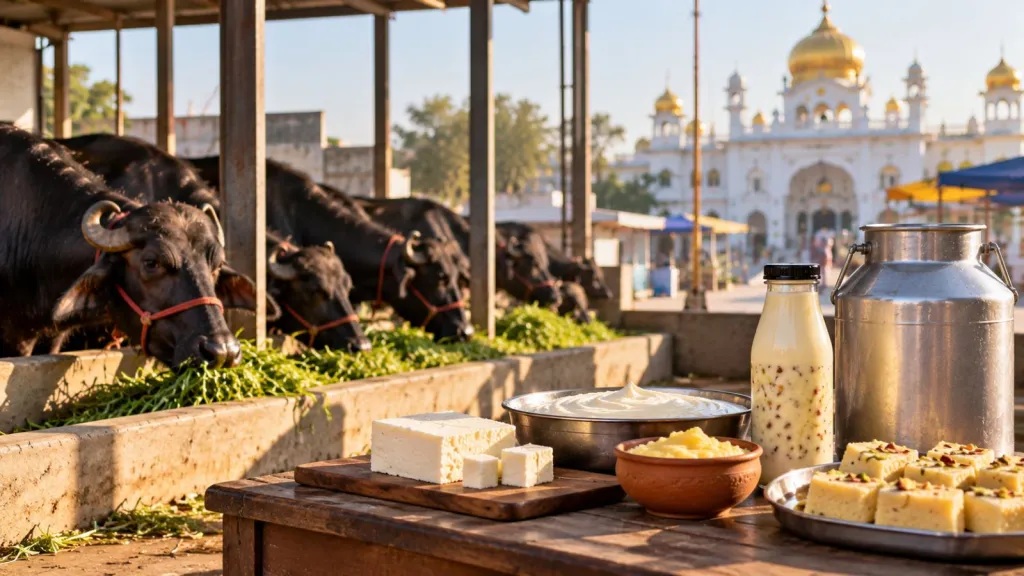
The core production foundation involves managing daily milk collections of approximately 1.5 quintals (150 kilograms) from the home herd, supplemented by an additional quintal sourced under quality-tested agreements from extended family operations to meet rising retail demand. Buffalo breeds like Murrah and Nili-Ravi provide a crucial processing advantage due to high milk solids, with butterfat levels commonly testing between 7.0 and 8.5 percent and protein fractions exceeding 4.0 percent. This natural concentration of milk solids makes buffalo milk the preferred industrial substrate across northern India for producing traditional indigenous dairy products. By capitalizing on biological solids density, the operation processes raw volumes into shelf-stable, high-margin dairy items that capture substantial retail value compared to selling unchilled raw milk to informal village middlemen.
The operational strategy relies on complete vertical integration, eliminating commission agents, private bulk aggregators, and cooperative wholesale margins. Instead of selling liquid milk into bulk procurement channels at discounted base rates, the enterprise processes milk daily into high-demand traditional dairy matrices, including fresh paneer, traditional curd (dahi), sweetened almond milk (milk badam), cultured buttermilk, traditional milk fudge (barfi), and slow-cooked clarified butter (pure desi ghee). Retailing twice daily directly to consumer foot traffic outside prominent pilgrimage and community hubs—such as Gurdwara Baba Deep Singh Shaheed—the farm captures premium pricing, realizing Rs 80 per kilogram for whole fluid milk, Rs 480 per kilogram for fresh paneer, Rs 800 per kilogram for artisanal barfi, and Rs 1,500 per kilogram for small-batch desi ghee.
From an enterprise finance and operating margin perspective, the direct-to-consumer processing structure delivers gross operating margins hovering near 50 percent, far exceeding standard production margins realized by conventional milk producers. Reinvesting operational cash flows enabled the operators to eliminate early herd financing balances, expand livestock housing, and diversify family income streams through commercial transport assets. Strong consumer demand for verified pure, unadulterated dairy fats has outstripped existing cooking capacity, prompting the enterprise to lease a permanent commercial retail storefront adjacent to major consumer foot corridors. This commercial transition from temporary street marketing to brick-and-mortar retailing establishes a scalable commercial footprint that stabilizes working capital reserves and eliminates cyclical retail revenue fluctuations.
At the broader agricultural sector level, the venture highlights the transformative economic potential of farm-level value addition within India’s massive, highly fragmented dairy sector. Smallholders owning minimal arable acreage often struggle to achieve economic viability solely through conventional cereal farming or selling raw milk into commodity collection networks. By mastering artisanal dairy processing protocols, ensuring consistent hygiene standards, and building transparent brand equity anchored on product purity, micro-dairy operators can insulate household balance sheets from feed cost inflation and wholesale price volatility. Heading into 2027, scalable direct-marketing models will remain vital to revitalizing rural household economies, driving youth and female entrepreneurship, and securing high-value returns across the South Asian dairy landscape.
Source: The Indian Express
You can now read the most important #news on #eDairyNews #Whatsapp channels!!!
🇮🇳 eDairy News ÍNDIA: https://whatsapp.com/channel/0029VaPidCcGpLHImBQk6x1F