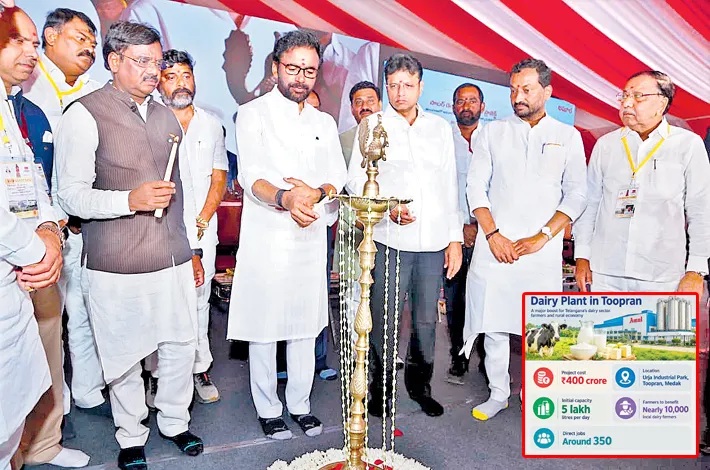

Construction begins on an Amul dairy processing plant in Medak to expand regional value-added manufacturing and procurement networks.
A major capital investment has officially broken ground in southern India as Sabar Dairy, a key constituent cooperative under the Gujarat Cooperative Milk Marketing Federation, commenced work on an advanced Amul dairy processing plant in Medak district, Telangana. The project represents a capital commitment of Rs 400 crore allocated to develop a mega integrated manufacturing facility situated within the Urja Industrial Park at Toopran. Designed to operate with an initial milk intake capacity of 500,000 liters per day, the industrial complex establishes a strategic procurement footprint intended to transform regional supply chains. Government officials and industrial leadership inaugurated the foundation ceremony, highlighting the facility as an essential milestone for strengthening allied agricultural infrastructure across the Deccan plateau. The development is projected to integrate roughly 10,000 dairy farmers into formal commercial channels while generating approximately 350 direct industrial jobs within the manufacturing zone.
From an engineering and operational standpoint, the Toopran plant is configured to process raw milk across diverse consumer product verticals to maximize farmgate milk utilization and throughput. Automated receiving bays and energy-efficient pasteurization lines will anchor initial operations, converting incoming raw milk into high-volume liquid milk pouches, cultured curd, and fresh paneer. Industrial capacity will also feature specialized processing lines dedicated to churning traditional clarified butter, manufacturing value-added fermented beverages such as lassi and spiced buttermilk, and producing hard ice cream. In addition, the industrial complex integrates commercial bakery and dairy dessert operations to capture evolving urban convenience demands throughout nearby metropolitan consumption centers. Advanced cold-chain distribution networks and localized bulk storage units will preserve strict bacteriological quality standards, ensuring shelf-stable preservation from farmgate collection to retail display.
This manufacturing expansion marks a significant scaling of the cooperative’s regional operational capacity since its initial procurement entry into Telangana in 2015. Sabar Dairy presently collects more than 100,000 liters of raw milk daily from organized village societies across surrounding rural districts, funneling volumes primarily into basic liquid distribution channels. Shifting from localized primary collection toward a diversified, vertically integrated processing hub enables the enterprise to address structural margin pressures in raw milk marketing. Rising disposable incomes and accelerated urban migration across the Hyderabad metropolitan region continue to drive double-digit retail consumption growth for branded fresh dairy products and premium chilled desserts. By expanding processing capacity to half a million liters daily, the cooperative enhances its competitive position against established private sector dairies and incumbent regional state federations competing for urban market share.
The Rs 400-crore project represents a strategic capital allocation aligned with broader industrial development initiatives promoted under the state’s long-term economic frameworks. Structured under the Invest Telangana campaign and the broader economic vision targeted toward 2047, the capital expenditure benefits from dedicated industrial zone infrastructure, including prioritized power grids and express logistics connectivity. State industry officials emphasized that providing institutional backing for mega agribusiness processing hubs helps attract organized investment while revitalizing secondary manufacturing hubs outside overcrowded urban clusters. Allocating substantial capital toward integrated food processing parks reduces transport depreciation and curtails costly post-harvest supply spoilage across regional milk sheds. By establishing modernized processing assets within the Urja Industrial Park, the cooperative creates a durable capital base that supports scalable future expansion without necessitating burdensome debt restructuring.
Beyond pure physical asset deployment, the project structurally reinforces smallholder dairy economics by expanding the reach of the cooperative procurement framework. Under the cooperative architecture, up to 80 percent of every consumer rupee spent on packaged dairy goods is returned directly to registered milk producers through transparent farmgate disbursements. This equitable margin distribution safeguards smallholder rural households against price suppression from informal middlemen and speculative milk vendors operating in unorganized regional markets. Regional administrators highlighted that establishing an organized institutional buyer provides steady cash flow for livestock maintenance, feed procurement, and herd genetic improvement. As the Toopran processing complex moves toward mechanical commissioning, the guaranteed demand pool is anticipated to stabilize village farmgate milk pricing and stimulate long-term rural dairy capital formation across Telangana.
Source: Metro India
You can now read the most important #news on #eDairyNews #Whatsapp channels!!!
🇮🇳 eDairy News ÍNDIA: https://whatsapp.com/channel/0029VaPidCcGpLHImBQk6x1F