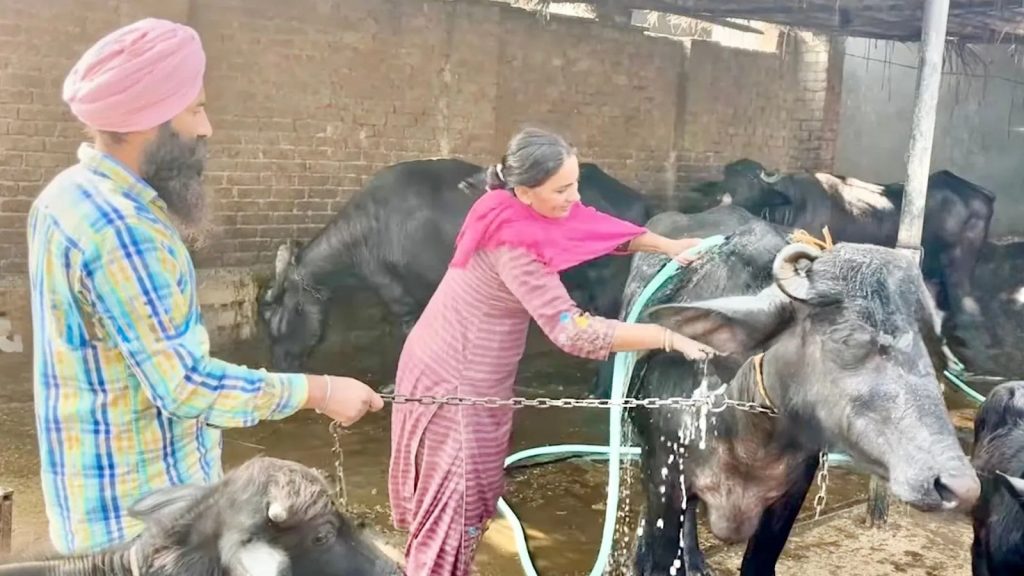




BA graduate Gurdeep Singh leverages homegrown fodder loops and self-replacement breeding to build a highly profitable alternative to rural migration.
Gurdeep Singh, a 35-year-old resident of Bhagi Bandar village in the Bathinda district of Punjab, has built an integrated, debt-free livestock breeding and cropping enterprise valued at ₹1 crore. Rejecting the widespread regional trend of youth emigration, Singh resigned from his administrative clerical post in 2014 to pursue primary production. Over a ten-year development period, he expanded his family’s initial holding of two household buffaloes and a single purchased Beetal goat into a diversified commercial operation. The farm currently generates an annual gross turnover of ₹36–37 lakh, yielding a highly stable net income of approximately ₹25 lakh.
The core revenue engine of the business is a high-grade dairy herd consisting of 21 to 22 Neeli Ravi and Murrah buffaloes, with 10 to 12 animals in milk at any given time. By prioritizing direct-to-household distribution channels rather than selling to mass processing intermediaries, the farm secures premium retail margins, bringing in annual milk revenues between ₹18 lakh and ₹20 lakh. Crucially, Singh maintains a strict self-replacement policy, rearing all his own replacement heifers to preserve genetic continuity, protect biosecurity, and insulate the business from high livestock purchasing costs.
Parallel to the dairy operation, the farm’s Beetal goat breeding division contributes an additional ₹6–7 lakh in net annual returns. Adhering to a patient herd-expansion philosophy, Singh systematically retains all female progeny to scale up his breeding nucleus, which now stands at 50 mature does. The farm commercially distributes more than 50 kids annually, with young stock commanding prices between ₹10,000 and ₹12,000 per head, while premium breeding-age animals fetch up to ₹30,000. This dual-species framework provides immediate cash liquidity and functions as a dynamic safety asset class.
The enterprise operates on an 11-acre land base, combining 8 acres of inherited family land with 3 acres of leased agricultural acreage. Singh has strategically engineered his cropping rotations to function as a closed-loop feed supply system for the animals, cultivating silage-grade maize, high-bulk green forage, short-duration paddy, wheat, and summer moong. Producing the vast majority of the herd’s nutritional requirements internally shields the operation from volatile market commodity prices and keeps total variable feeding costs at a fraction of standard commercial dairy layouts.
Operating entirely without institutional or private debt, the farm is managed exclusively via family labor, utilizing inputs from Singh, his parents, and his wife. The steady cash flows generated by the livestock have enabled the operation to purchase an additional acre of agricultural land and a 500-square-yard residential site. Now serving as an informal regional training hub, the Bhagi Bandar farm hosts multiple visiting producers each week, with Singh actively advocating for small-scale, quality-focused initial entries backed by heavy profit reinvestment and rigorous, science-based genetic management.
Source: The Indian Express
You can now read the most important #news on #eDairyNews #Whatsapp channels!!!
eDairy News ÍNDIA: https://whatsapp.com/channel/0029VaPidCcGpLHImBQk6x1F