

India’s Sahiwal cattle breeding program has reached a significant scientific milestone after the ICAR–Indian Veterinary Research Institute (ICAR-IVRI) successfully produced indigenous Sahiwal calves using a combination of advanced assisted reproductive technologies.
The achievement marks the institute’s first successful application of ultrasound-guided ovum pick-up, in vitro fertilization and embryo transfer (OPU-IVF-ET), establishing a new platform for accelerating the genetic improvement of India’s indigenous dairy breeds.
The initiative began during 2022-23, when ICAR-IVRI launched a dedicated research program aimed at strengthening the genetic potential of indigenous bovines. Scientists focused on standardizing OPU-IVF-ET protocols under both farm and field conditions, targeting Sahiwal, Tharparkar cattle and Murrah buffalo.
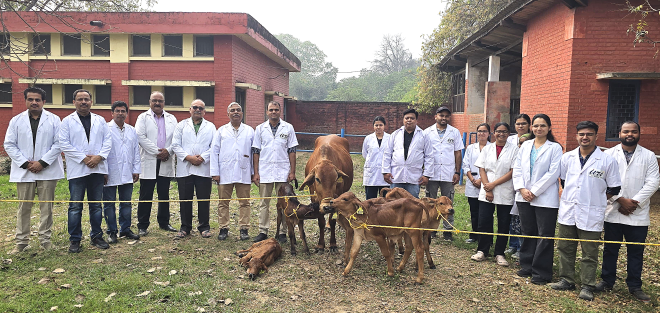
The research reached a major milestone beginning on 28 February 2026, when five healthy Sahiwal calves were born within a period of five days using the assisted reproductive protocol.
According to the institute, the calves were produced from superior genetic material. The donor animal was a high-yielding Sahiwal cow producing more than 12 litres of milk per day, while fertilization used semen from a proven bull whose maternal lineage recorded an approximate 3,320-kilogram lactation yield.
The program also demonstrated strong laboratory performance throughout the reproductive process.
Researchers successfully recovered oocytes under non-stimulated conditions, achieving average recoveries of approximately 14.5 oocytes in Tharparkar cattle, 13.14 in Sahiwal cattle, and between 4.5 and 5.5 in Murrah buffalo.
Embryo production efficiency also reached high levels, with blastocyst development exceeding 47% in cattle and more than 42% in buffalo, performance that the institute said is comparable with leading international laboratories.
Beyond the immediate scientific achievement, ICAR-IVRI views the technology as a scalable approach for expanding the production of genetically superior indigenous cattle and buffalo.
The institute plans to extend the use of OPU-IVF-ET to support larger genetic improvement programs while contributing to the conservation of India’s indigenous bovine germplasm.
Alongside research, ICAR-IVRI is also investing in workforce development through practical training programs focused on assisted reproductive technologies. The institute says these initiatives are intended to build technical expertise, encourage entrepreneurship and support new ventures within India’s livestock sector.
The project was carried out by a scientific team led by Dr. Brijesh Kumar, working with researchers from multiple divisions and supported by research scholars. The program was guided by Dr. S. K. Singh, Joint Director (Research), with institutional support from senior scientists and previous institute leadership.
Commenting on the achievement, Raghavendra Bhatta, Deputy Director General (Animal Science), ICAR, and Director of ICAR-IVRI, said the success is expected to create new opportunities for further advances in assisted reproductive technologies.
For India’s dairy industry, the milestone represents another step toward combining modern reproductive science with the long-term improvement and conservation of indigenous dairy breeds, reinforcing efforts to enhance productivity while preserving valuable native genetics.
Produced by eDairyNews, with information published by Department of Animal Sciences, ICAR.