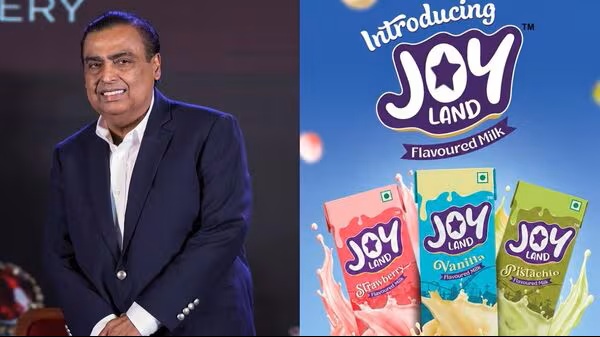




Fast-moving consumer goods arm enters the ready-to-drink segment with Joyland flavoured milk priced at ₹20, taking on established dairy brands across India.
Reliance Consumer Products Limited, the fast-moving consumer goods arm of Reliance Industries, has officially entered the ready-to-drink dairy beverage market with the launch of its Joyland flavoured milk brand priced at ₹20 per unit. Initial commercial distribution has debuted across retail channels in Tamil Nadu featuring classic strawberry and vanilla formulations, with phased nationwide expansion planned across modern supermarket trade, neighborhood kirana stores, and digital quick-commerce platforms. The rollout marks a strategic extension of the group’s value-driven pricing model into refrigerated and ambient dairy beverages, replicating the disruptive ₹20 price-point strategy previously deployed in carbonated soft drinks. This commercial push aligns with the conglomerate’s broader corporate objective of generating ₹1 lakh crore in annual consumer goods revenue by fiscal year 2030, leveraging deep nationwide retail penetration to accelerate product sampling and repeat household purchases.
From an industrial processing and manufacturing perspective, the commercial rollout is supported by ongoing capital expenditure into vertically integrated mega food parks and advanced automated packaging lines. Unlike carbonated soft drinks, ready-to-drink dairy formulations require sterile ultra-high-temperature (UHT) processing or specialized aseptic bottling to achieve ambient shelf stability and maintain product integrity without extensive cold-chain dependency. To support downstream dairy manufacturing, the enterprise is leveraging newly commissioned beverage facilities designed to deliver substantial conversion efficiencies and low unit production costs. Formulated with authentic dairy solids, the product pipeline is slated to incorporate additional regional flavor profiles, high-protein formulations, and functional breakfast dairy beverages as production capacities scale across central and northern industrial corridors.
In terms of competitive market dynamics, the strategic launch initiates a direct contest with entrenched dairy cooperatives and multinational consumer goods manufacturers, including Amul Kool, ITC’s Sunfeast Smoodh, Mother Dairy, Karnataka Milk Federation’s Nandini, and CavinKare’s Cavin’s. India’s ready-to-drink flavoured milk market has demonstrated rapid structural growth, expanding from ₹4,420 crore in 2021 to an estimated ₹7,600 crore in 2025, with industry projections estimating the segment to reach ₹8,360 crore in 2026 at an annual expansion rate of 10 percent. Rapid urbanization, rising disposable incomes, and increasing health consciousness among young consumers have fueled a consistent shift toward convenient, nutrient-dense packaged beverages over traditional carbonated soft drinks. By establishing a presence in this high-velocity category, consumer goods conglomerates aim to capture attractive retail margins by transforming baseline liquid milk into value-added dairy beverages.
From a balance sheet and financial performance standpoint, the entry into dairy beverages strengthens the enterprise’s Total Beverage portfolio, which generated ₹2,900 crore in revenue during the first quarter of fiscal year 2027 alone. Maintaining a low consumer entry price of ₹20 leaves narrow gross profit margins, particularly given historical price fluctuations in farmgate milk, skim milk powder, and dairy fat commodities. To safeguard operational profitability, the company relies on automated supply chain logistics, centralized ingredient procurement, and integrated retail distribution through thousands of company-owned stores and dark store logistics hubs. Deploying capital into vertically integrated production hubs allows the corporate group to lower per-unit conversion costs and compete effectively against traditional dairy cooperatives that have historically dominated regional distribution networks.
At the farmgate procurement level, the entry of major consumer goods conglomerates into the ready-to-drink dairy sector is poised to reshape commercial milk utilization and farm-level demand patterns. Unlike cooperative federations anchored by direct farmer member networks, corporate entrants often source high-quality raw milk through contract farming arrangements, third-party dairy processors, and bulk milk solids procurement. As distribution expands into multiple regional markets heading into 2027, rising commercial demand for standardized milk solids will provide dairy processors and commercial dairy farmers with lucrative wholesale channels outside conventional liquid milk pouch sales. Sustained corporate competition in value-added dairy processing will ultimately benefit milk producers who invest in clean milk production, automated milking systems, and high compositional standards.
Source: The Economic Times
You can now read the most important #news on #eDairyNews #Whatsapp channels!!!
🇮🇳 eDairy News ÍNDIA: https://whatsapp.com/channel/0029VaPidCcGpLHImBQk6x1F