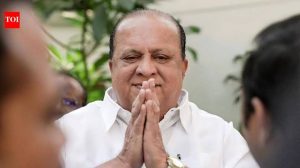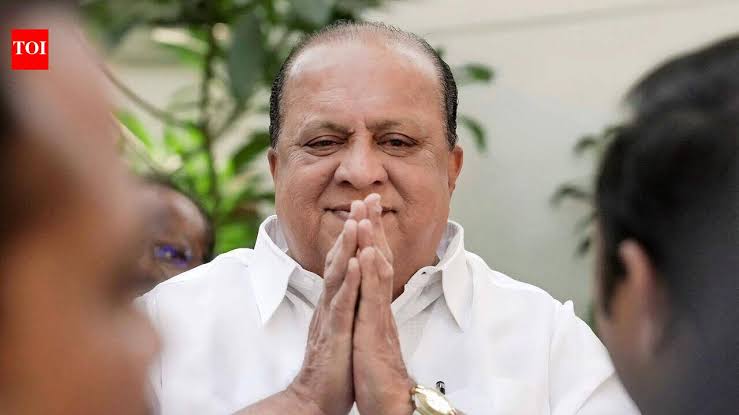




Maharashtra cabinet minister Hasan Mushrif claims political plot after Mahayuti-backed panel loses Gokul dairy board majority to Congress rival Satej Patil.
Senior Maharashtra cabinet minister and Nationalist Congress Party (NCP) leader Hasan Mushrif has characterized the defeat of his son and political heir, Navid Mushrif, in the Kolhapur District Cooperative Milk Producers Union elections as a “pre-determined conspiracy.” The high-stakes contest for control of the dairy federation, widely recognized by its flagship consumer brand name Gokul, concluded with the panel aligned with the state’s ruling Mahayuti coalition securing 12 seats, while the rival panel spearheaded by Congress Member of the Legislative Council Satej “Bunty” Patil captured a decisive 13-seat majority across the 25-member board. The narrow outcome deprives the ruling alliance of executive control over Maharashtra’s largest dairy cooperative and ends Navid Mushrif’s tenure, who served as the federation’s chairman during the final year of the outgoing term.
Speaking publicly for the first time since the election at an agro-industrial event marking the start of the regional sugarcane crushing season, Mushrif asserted that booth-level voting patterns substantiated his allegations of targeted cross-voting and backroom political maneuvers. Mushrif, who has represented his legislative constituency across six consecutive assembly terms and currently oversees the state’s medical education portfolio, maintained that while electoral setbacks force leaders to reconnect with their grassroots foundations, the outcome at Gokul was shaped by calculated internal sabotage rather than genuine farmer rejection. His statements underscore the intense factional fault lines running through Maharashtra’s cooperative agro-complex, where district dairy unions and cooperative sugar factories serve as primary economic engines and political power bases.
Other senior leaders within the Mahayuti alliance offered contrasting assessments of the election loss. State Health Minister Prakash Abitkar acknowledged that overconfidence undermined the ruling coalition’s campaign, cautioning that organizers may have taken cooperative voting delegates and primary milk societies for granted. Concurrently, Rajya Sabha Member of Parliament Dhananjay Mahadik attributed the electoral reversal to strategic administrative missteps, citing delayed candidate selection and insufficient time to engage directly with voter-delegates, while accusing Patil’s campaign of circulating misleading campaign narratives. Mahadik affirmed that the 12-member Mahayuti contingent will form a constructive opposition within the cooperative board, pledging to endorse policies that benefit the cooperative while actively challenging decisions detrimental to dairy farmer welfare.
From an enterprise governance and cooperative operational standpoint, the political polarization surrounding the board election arrives at a critical juncture for Gokul’s commercial operations. Managing a dairy federation with an annual turnover exceeding ₹3,960 crore requires operational stability across milk collection routes, chilling centers, and processing plants. Gokul relies on daily milk intake sourced from over 8,000 village-level primary cooperative societies, representing roughly 4.4 lakh smallholder producers. Maintaining seamless raw milk aggregation and distribution—particularly into major urban liquid milk markets such as Mumbai and Pune—demands that the newly elected board navigate board-level opposition without allowing political rancor to disrupt procurement pricing, cattle feed subsidies, or logistics contracts.
Looking ahead toward 2027, the contested election outcome at Gokul highlights the delicate balance between cooperative enterprise management and regional political alignment in western Maharashtra. With the Patil-led panel poised to elect a new board chairman, the cooperative’s leadership must focus on defending operating margins against feed and transportation cost inflation while maintaining farmgate milk check transparency. Ensuring professional corporate management and shielding commercial dairy operations from partisan disputes will be essential to safeguarding member equity, preserving consumer trust in the Gokul brand, and sustaining long-term economic development across the district’s rural milk shed.
Source: The Times of India
You can now read the most important #news on #eDairyNews #Whatsapp channels!!!
🇮🇳 eDairy News ÍNDIA: https://whatsapp.com/channel/0029VaPidCcGpLHImBQk6x1F