



A Division Bench sets aside a ₹43.43 crore Amul cross charge GST demand, affirming nil valuation for internal corporate services between cooperative head offices and branches.
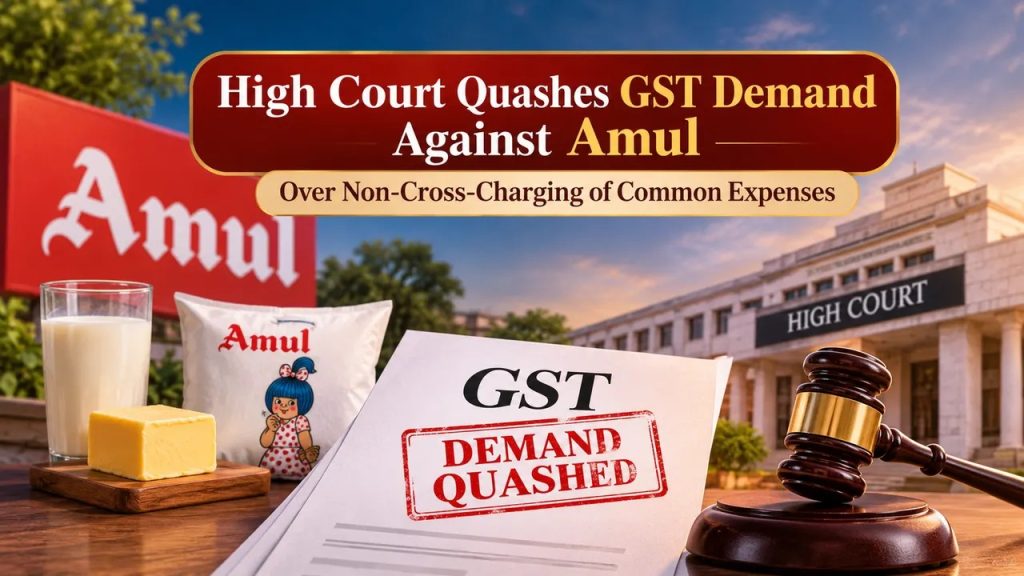
The Gujarat High Court has set aside an integrated goods and services tax assessment totaling ₹43,43,12,441 against Gujarat Co-operative Milk Marketing Federation Limited, eliminating a significant tax liability stemming from internal administrative cost sharing. Presided over by a Division Bench comprising Justice A.S. Supehia and Justice Vaibhavi D. Nanavati, the judgment quashed an Order-in-Original issued by central tax authorities that sought to levy tax, interest, and penalties for the period between July 2017 and March 2019. Revenue authorities had alleged that the cooperative federation failed to cross-charge head office expenses to its nationwide network of marketing branches and sales depots, claiming deliberate non-disclosure under Section 74 of the Central Goods and Services Tax Act. The judicial ruling decisively dismissed allegations of fraud or willful suppression, affirming that statutory tax evasion provisions cannot be invoked merely because an enterprise manages common corporate functions centrally without issuing internal cross-charge invoices.
From an administrative and operational network perspective, the cooperative apex body coordinates vast national commercial activities from its registered headquarters in Anand, Gujarat. Operating as the umbrella marketing federation for millions of dairy producers across district unions, the central office incurs consolidated expenditures covering brand advertising, national publicity campaigns, information technology systems, annual maintenance contracts, and legal representations. Revenue auditors contended that these corporate services and central employee costs directly benefited regional branch offices and distribution depots, arguing that distinct state GST registrations constituted distinct legal persons requiring proportional taxable billing. However, judicial analysis established that all central corporate expenditures were fully disclosed across official ledgers, financial statements, and audited balance sheets. The court clarified that centralizing marketing and managerial logistics represents a standard organizational structure rather than an artificial mechanism designed to avoid statutory tax obligations.
The legal determination centered on valuation mechanisms governing supply transactions between distinct establishments under Rule 28 of the CGST Rules. Central Board of Indirect Taxes and Customs circulars clarify that where a recipient branch office is entitled to claim full input tax credit, the value declared by the head office on an invoice is legally deemed to represent the open market value. In circumstances where the administrative headquarters does not issue an invoice for shared corporate services, the statutory value is legally accepted as nil under the second proviso to Rule 28. Because the regional sales depots and branch offices of the dairy cooperative maintained full eligibility to claim input tax credits, the transaction was revenue-neutral, meaning no net tax revenue was withheld from the public treasury. Consequently, the High Court rejected the revenue department’s arbitrary approach of apportioning corporate overheads against regional branch turnovers to fabricate taxable turnover.
From a cooperative finance and balance sheet perspective, the quashing of the ₹43.43 crore tax notice eliminates a substantial contingent liability that threatened cooperative working capital. Cooperative marketing federations operate under lean gross margins, prioritizing maximum milk procurement payouts over retained corporate cash reserves. Forcing large multi-state cooperatives to fund upfront tax assessments alongside statutory penalties ties up liquidity in protracted appellate escrow accounts, elevating short-term financing costs and interest expenses. Furthermore, the judicial affirmation that administrative non-invoicing carries a nil valuation establishes decisive precedent across the agribusiness and consumer goods sectors, providing legal protection against retrospective transfer pricing assessments on internal shared services. Dairy enterprises can now deploy capital into operational warehousing, automated logistics, and brand campaigns without the overhang of arbitrary service tax cross-charge liabilities.
At the farmgate procurement level, the resolution of multi-crore indirect tax disputes directly protects the income distribution channels of member dairy farmers. Cooperative federations function by funneling trading surpluses back to district cooperative unions, which in turn distribute annual price difference bonuses and veterinary support services to village producers. When regulatory bodies impose arbitrary tax assessments on corporate marketing activities, the resulting fiscal strain risks depressing procurement incentives and eroding producer margins during inflationary periods. Establishing clear indirect tax treatment for shared logistics and promotional spending ensures that cooperative operating margins remain dedicated to sustaining rural milk collection networks. Moving toward 2027, this landmark judicial precedent reinforces fiscal certainty for India’s dairy federations as they expand interstate distribution footprints and modernize supply chain infrastructure.
Source: StudyCafe
You can now read the most important #news on #eDairyNews #Whatsapp channels!!!
🇮🇳 eDairy News ÍNDIA: https://whatsapp.com/channel/0029VaPidCcGpLHImBQk6x1F