



Enforcement raids in Pratapgarh and Amethi uncovered industrial-grade acetic acid, seven-day-old paneer and curd, and severe hygiene lapses, resulting in immediate closures and 10 laboratory samples.
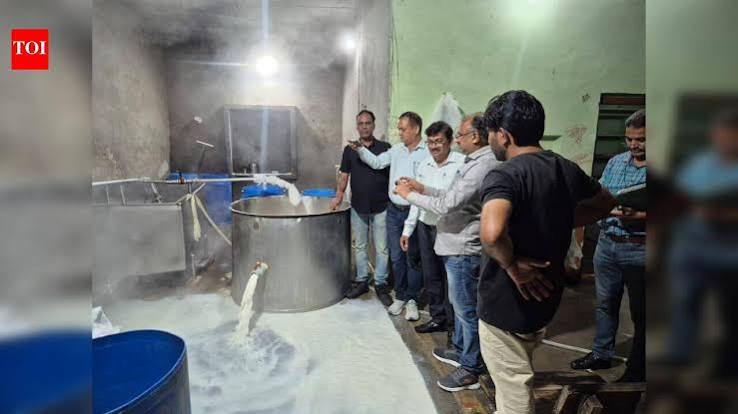
Food safety authorities in Uttar Pradesh have shut down three dairy product manufacturing units across Pratapgarh and Amethi and destroyed stale paneer, cream, and curd valued at ₹3.93 lakh on the spot after inspections uncovered severe hygiene violations and unauthorized processing inputs. Carried out under a statewide enforcement drive directed by Food Safety and Drug Administration (FSDA) Commissioner Dr. Roshan Jacob, the raids targeted unhygienic manufacturing practices and suspected adulteration in fresh dairy staples.
During the coordinated operation, enforcement teams documented critical food-safety breaches across all three facilities before halting operations and collecting 10 product samples—five from Pratapgarh and five from Amethi—for laboratory testing:
-
Pratapgarh Facility Violations: Licensed solely to manufacture khoya, the unit was producing roughly 10 quintals of paneer daily without distribution records, alongside ghee. Inspectors found containers labeled “Acetic Acid Glacial (For Industrial Use Only)” kept for paneer coagulation, foul odors, cobwebs, paneer stored in a dirty tank, and roughly 170 kg of uncovered cream plus open khoya exposed to flies.
-
Amethi Unit Closures: At one paneer facility in Amethi, officers found roughly 195 kg of seven-day-old stale paneer (valued at around ₹42,000) stored amid filth and foul odors, while a second unit—Ram Dhadaka Foods—held 358 kg of seven-day-old curd (estimated at ₹18,620), all of which was destroyed on site.
Laboratory Follow-Up and Zero-Tolerance Enforcement: Samples of paneer, mixed milk, cream, curd, and khoya were dispatched to state laboratories to determine chemical and microbiological non-compliance ahead of further legal action.
For India’s organized dairy sector, recurring enforcement sweeps against informal and non-compliant processors highlight the sharp divide between regulated milk plants and unmonitored local units. Unsanitary storage, expired stocks, and industrial coagulants pose direct public-health risks while undercutting compliant dairies that invest in cold-chain integrity, food-grade inputs, and traceability.
Strict regulatory follow-through—combining surprise inspections, on-site destruction of unsafe stock, and lab-backed prosecution—remains essential to protecting consumer confidence in fresh Indian dairy categories such as paneer, curd, cream, and khoya.
Source: The Times of India
You can now read the most important #news on #eDairyNews #Whatsapp channels!!!
🇮🇳 eDairy News ÍNDIA: https://whatsapp.com/channel/0029VaPidCcGpLHImBQk6x1F