

Released on November 25, 2026, ahead of National Milk Day honoring Dr. Verghese Kurien, an official factsheet reported by Telangana Today shows India’s milk output rose 69.41% to 247.87 million tonnes in 2024–25 while expanding producer cooperatives and women-led organizations.
India maintained its position as the world’s largest milk producer in 2024–25, with national milk output surging 69.41 percent over a decade to reach 247.87 million tonnes, according to an official government factsheet reported by Telangana Today via IANS on November 25, 2026. Released ahead of National Milk Day—observed annually on November 26 to mark the birth anniversary of Dr. Verghese Kurien, widely recognized as the Father of India’s White Revolution—the factsheet underscores how sustained productivity gains, state concentration, and organized farmer collectives have consolidated India’s status as a global dairy powerhouse accounting for roughly one-fourth of world milk production.
Over the eleven-year span from 2014–15 to 2024–25, milk production expanded from 146.31 million tonnes at a compound annual growth rate (CAGR) of 5.41 percent, delivering major gains in per-capita availability, animal productivity, and rural income:
-
Output, Per-Capita Supply, and Yield: Per capita milk availability climbed 52.03 percent from 319 grams per person per day in 2014–15 to 485 grams per person per day in 2024–25, while average bovine milk productivity rose 69 percent from 1,640 kg to 2,800 kg per animal per year.
-
Regional Production Concentration: Five states—Uttar Pradesh, Rajasthan, Madhya Pradesh, Gujarat, and Maharashtra—accounted for 54.09 percent of India’s total milk production, with Uttar Pradesh leading at a 15.66 percent share.
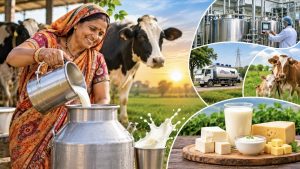
Rural Livelihoods and Workforce: Dairy farming supports 8.5 crore (85 million) rural households, with women accounting for nearly 70 percent of the dairy farming workforce.
Structured cooperative and producer institutions play a central role in linking rural suppliers to formal processing and marketing channels. According to the factsheet, India’s dairy cooperative network encompasses 22 milk federations, 241 district cooperative milk unions, 28 marketing dairies, and 25 Milk Producer Organisations (MPOs) spanning nearly 2.45 lakh (245,000) villages and 1.65 crore (16.5 million) dairy farmers.
Institutional support through the National Dairy Development Board Dairy Services (NDDB-DS) has also accelerated producer-owned enterprises and women’s governance roles:
-
Milk Producer Organisations (MPOs): NDDB-DS had established 25 MPOs as of October 31, 2026, covering more than 13 lakh (1.3 million) milk producers across 175 districts in 12 states.
-
Women-Led Governance: Nearly 18 of the 25 MPOs operate with all-women membership and women serving as all producer directors on their boards, strengthening women’s leadership and economic standing within organized dairy value chains.
For global dairy observers and agribusiness stakeholders, India’s steady 5.41 percent annual output growth and expanding cooperative infrastructure highlight the scale of domestic production and consumption in the world’s largest milk market. While domestic demand absorbs the overwhelming share of production, continued investments in herd productivity, milk collection, and producer organizations shape both rural resilience and India’s long-term role in international dairy trade.
As India marks National Milk Day on November 26, the factsheet’s figures illustrate the enduring legacy of Dr. Verghese Kurien’s cooperative model alongside modern efforts to raise yields, expand farmer collectives, and empower women across rural India.
Source: Telangana Today
You can now read the most important #news on #eDairyNews #Whatsapp channels!!!
🇮🇳 eDairy News ÍNDIA: https://whatsapp.com/channel/0029VaPidCcGpLHImBQk6x1F