


Social Justice Department awards three-year centralized procurement contract to Parag Milk Foods and Warana cooperative at ₹26.40 per pack.
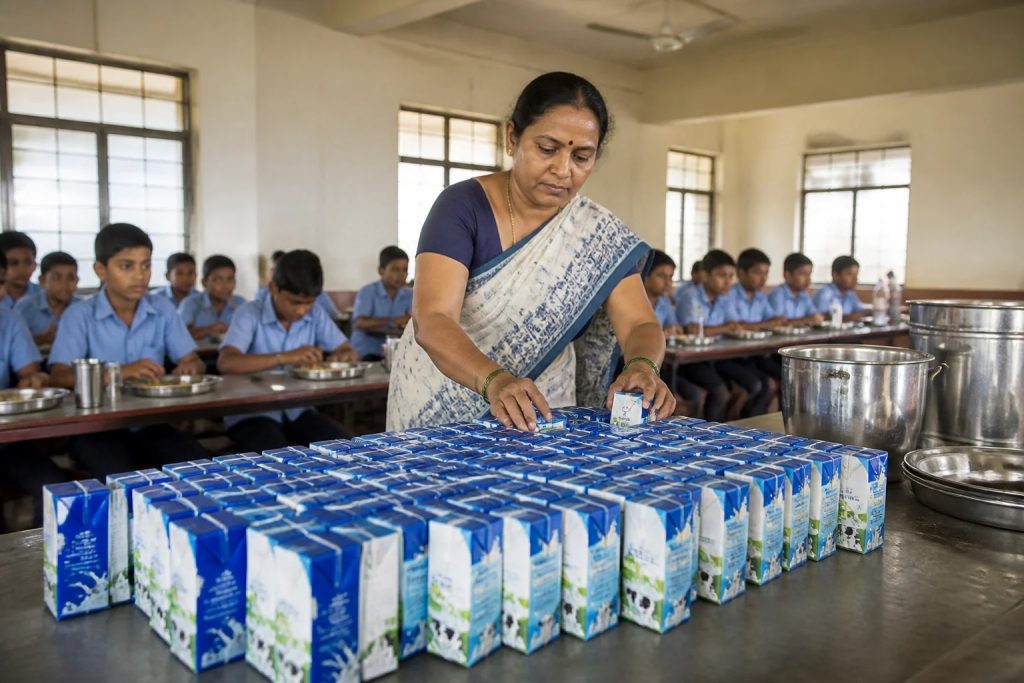
The Government of Maharashtra’s Social Justice and Special Assistance Department has initiated a major overhaul of its institutional nutritional welfare scheme, transitioning from decentralized local dairy procurement to packaged, flavored milk distribution. As reported by Urban Acres and based on a state government resolution (GR) issued on August 31, the state will supply 200 ml aseptic Tetra Pak cartons of flavored milk to more than 65,000 residential students. The centralized scheme officially took effect on September 15, terminating the temporary milk supply arrangements previously negotiated by individual facility administrators.
The program covers 46,663 students housed across 449 government-run social welfare hostels and 18,600 students enrolled in 92 state residential schools. Following an e-tendering evaluation overseen by the state-level administrative procurement committee, the supply price was fixed at ₹26.40 per 200 ml unit. The approved rates and procurement terms are locked under a binding three-year contract without provision for interim rate revisions, while stipulating immediate contract cancellation if suppliers fail to maintain verified product quality standards or timely delivery schedules.
To ensure efficient logistical coverage across Maharashtra’s vast geographic divisions, procurement responsibilities have been split between two prominent commercial dairy entities. Private dairy major Parag Milk Foods has been contracted to service hostels and residential schools located across the Mumbai, Nashik, Pune, and Latur divisions. Meanwhile, cooperative processor Shree Warana Sahakari Dudh Utpadak Prakriya Sangh (Warana) will manage the distribution network across the eastern and central administrative divisions of Nagpur, Amravati, and Chhatrapati Sambhajinagar.
While centralized aseptic packaging offers substantial logistical advantages—notably eliminating cold-chain dependency and extending shelf stability in remote rural facilities—the policy pivot has sparked debate among nutritional experts and student advocacy groups. Critics raise concerns regarding the substitution of fresh, unflavored liquid milk with sweetened, flavored formulations, pointing out that added sugars and industrial flavorings detract from core dietary objectives for growing adolescents. Furthermore, questions have been raised regarding the cost-benefit of paying ₹26.40 per 200 ml carton compared to expanding fresh local dairy procurement within rural economies.
The operational execution now shifts to the Office of the Social Welfare Commissioner, which must establish robust quality-control protocols across hundreds of decentralized institutional points of receipt. Key operational challenges will center on monitoring batch testing, gathering direct student feedback, and ensuring that delivery frequencies prevent inventory bottlenecks. For India’s institutional dairy sector, Maharashtra’s move demonstrates how government welfare schemes represent sizable, multi-year volume outlets for organized dairy processors capable of meeting large-scale UHT aseptic packaging requirements.
Source: Urban Acres
You can now read the most important #news on #eDairyNews #Whatsapp channels!!!
🇮🇳 eDairy News ÍNDIA: https://whatsapp.com/channel/0029VaPidCcGpLHImBQk6x1F