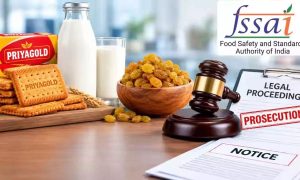



Federal food safety authorities initiate criminal prosecution against food and dairy processors over cattle feed bran in biscuits and substandard liquid milk fat.
The Food Safety and Standards Authority of India has formally initiated criminal prosecution proceedings against food and dairy manufacturing enterprises following comprehensive laboratory testing and intensive factory inspections. Sanctioned under the statutory provisions of the Food Safety and Standards Act of 2006, the legal enforcement actions target Surya Food and Agro Limited, the manufacturing entity behind the Priyagold brand, alongside commercial milk processor Dodla Dairy Limited and organic distributor UEIR Organic Foods. The prosecution follows the earlier administrative suspension of manufacturing licenses after regulatory inspection teams documented critical food safety breaches and industrial adulteration practices across production lines. State and central food safety commissioners have escalated the investigative findings into formal judicial complaints to impose statutory penalties and deter fraudulent raw material substitutions in mass-market packaged foods. This coordinated regulatory offensive highlights intensifying surveillance across fast-moving consumer goods manufacturing facilities and commercial dairy supply chains nationwide.
Surveillance audits triggered by formal consumer complaints uncovered severe operational and sanitary non-compliances inside commercial bakery and milk processing facilities. Investigative teams inspecting manufacturing facilities observed industrial gunny bags containing wheat bran explicitly labeled as intended for bovine cattle feed being integrated into commercial biscuit dough formulations. Audits also identified systemic failures in plant pest control, unsegregated raw material warehousing, cross-contamination risks in intermediate dough handling, and substandard employee sanitation protocols. Concurrently, regulatory sampling conducted on retail batches of Dodla Dairy full cream milk revealed significant compositional non-conformity, with laboratory analysis declaring the milk substandard due to insufficient milk fat percentages relative to national compositional parameters. Additional pesticide residue violations detected in commercial raisin consignments further demonstrated widespread supply chain contamination and a breakdown in internal quality assurance protocols.
The substitution of agricultural animal feed derivatives for food-grade ingredients and the commercialization of substandard milk reflect intense economic pressure on processing margins within consumer goods markets. Food-grade wheat bran requires rigorous milling, screening, and microbiological decontamination, trading at substantial price premiums over unrefined cattle feed bran that is legally restricted to livestock ruminant nutrition. By utilizing animal feed inputs to lower formulation costs, manufacturing entities capture illicit margin gains while exposing consumer markets to potential fungal mycotoxins, pesticide residues, and microbial hazards. Similarly, in the organized dairy sector, full cream liquid milk mandates a minimum statutory fat threshold of 6.0 percent in regional retail markets, representing the most expensive component in commercial dairy processing. When processors fail to maintain standardized milk fat levels, commercial fluid operations dilute product quality to capture short-term cost savings, directly undercutting compliant cooperative and private dairies that invest in precise standardization technologies.
The escalation of food safety violations into criminal prosecution introduces substantial balance sheet liabilities and brand equity risks for commercial food and dairy processors. Sustained license suspensions halt factory throughput, generate heavy carrying costs on perishable raw materials, and trigger punitive contractual default clauses with national supermarket chains and quick-commerce distribution platforms. For listed dairy entities and institutional packaged food manufacturers, regulatory enforcement actions can prompt severe valuation write-downs and increased scrutiny from commercial banking syndicates managing operational credit lines. Processing facilities facing formal sanction must deploy unbudgeted capital expenditures toward sanitary line retrofits, automated ingredient tracking systems, and accredited third-party batch testing to regain statutory operating licenses. Furthermore, institutional purchasers and enterprise retail partners are tightening vendor pre-qualification criteria, shifting supply agreements toward processors capable of providing verified batch provenance and audited compositional purity.
At the farmgate procurement level, vigorous regulatory enforcement against substandard milk fat and industrial feed diversion is vital to preserving transparent pricing for agricultural producers. When industrial manufacturers dilute milk solids or substitute animal feed into the human food chain, artificial demand distortions penalize genuine dairy farmers who invest in herd genetics, clean milk harvesting, and balanced nutrition. Strengthening laboratory screening protocols at regional milk collection points ensures that farmgate price incentives reward producers delivering raw milk with superior natural fat and protein content. Looking ahead toward 2027, the deployment of rapid molecular testing, continuous factory surveillance, and stringent penalties under Indian food safety frameworks will be critical to restoring consumer trust and maintaining fair market competition across the agro-industrial manufacturing sector.
Source: Business Standard
You can now read the most important #news on #eDairyNews #Whatsapp channels!!!
🇮🇳 eDairy News ÍNDIA: https://whatsapp.com/channel/0029VaPidCcGpLHImBQk6x1F