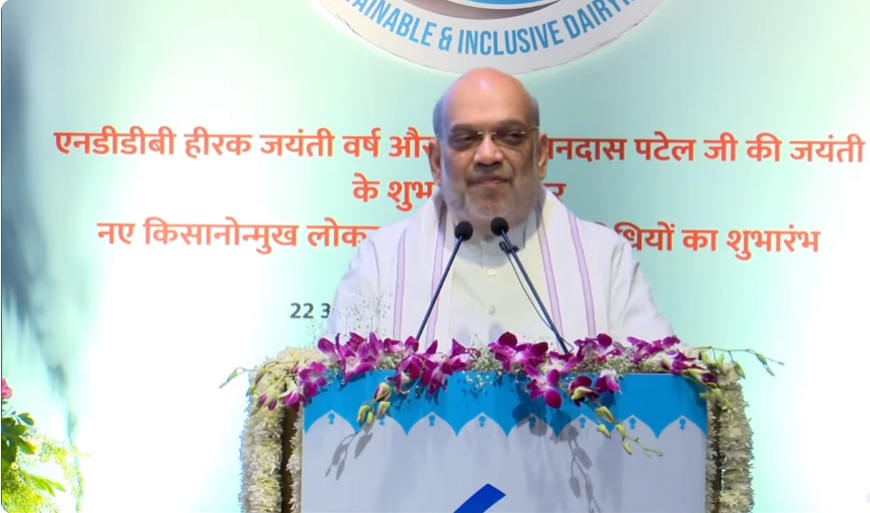



Union Minister Amit Shah details an ambitious cooperative-led strategy to link 8 crore milk producers, boost output, and eradicate middleman exploitation.
India is structurally positioning its massive dairy sector to launch “White Revolution 2.0,” a sweeping national initiative aimed at standardizing and expanding the country’s rural cooperative framework. Speaking at a high-level dairy industry assembly, Union Home and Cooperation Minister Amit Shah emphasized that the primary goal of this next-generation campaign is to systematically connect all 8 crore milk-producing families across the country to organized cooperative infrastructure. The multi-year strategy seeks to transition the sector away from unorganized, fragmented collection models that leave smallholders vulnerable to commercial exploitation.
Currently, India firmly holds the top position in global dairy production, generating an aggregate volume of 231 million tons. While the domestic dairy sector is expanding at a robust annual growth rate of 6 percent—well above the international average of 2 percent—a significant structural imbalance remains within the internal supply chain. Out of the 8 crore rural families managing dairy cattle daily, only 1.5 crore are formally integrated into the cooperative network, leaving approximately 6.5 crore families operating without fair, transparent farmgate pricing benchmarks.
To bridge this operational gap, the Ministry of Cooperation has finalized an aggressive infrastructure roadmap to establish 2 lakh new multipurpose cooperative societies over the next five years. This decentralized expansion will prioritize expanding formal milk routes and setting up village-level collection hubs in previously uncovered regional pockets. By shifting the raw milk pool into organized channels, the central government aims to boost formal milk procurement by 50 percent over the next five years while expanding specialized marketing dairies nationwide.
A central pillar of White Revolution 2.0 is the integration of sustainable technologies and circular economy principles directly into the smallholder farming model. The updated blueprint focuses heavily on secondary revenue generation for producers, notably through the roll-out of advanced cow dung management models and commercial compressed biogas projects managed by district milk unions. Under this framework, smallholders will receive direct financial benefit from the collection of up to 16 crore tonnes of manure, with 100 percent of processed carbon credits deposited directly into farmers’ bank accounts.
Furthermore, the macro-economic transformation places a strong emphasis on women’s empowerment and rural demographic stabilization, noting that women currently make up 72 percent of the cooperative dairy workforce. By introducing automated milk collection units, digital testing equipment, and direct banking systems, the initiative ensures that financial proceeds from milk procurement flow directly to female operators. This comprehensive farm-to-factory integration is designed to uplift marginal primary producers, curb rural-to-urban migration, and solidify India’s long-term competitive edge in the global dairy trade.
Source: News On Air
You can now read the most important #news on #eDairyNews #Whatsapp channels!!!
🇮🇳 eDairy News ÍNDIA: https://whatsapp.com/channel/0029VaPidCcGpLHImBQk6x1F