


Female producers manage 4,562 village societies, procuring 5.7M litres daily and driving financial inclusion across Banaskantha and state milk unions.
Women dairy producers across Gujarat are taking on expanding leadership and administrative roles within the state’s cooperative ecosystem, transitioning from traditional on-farm animal husbandry to managing village-level milk collection societies and cooperative boards. Over the past five years, the number of women-led primary dairy cooperative societies in Gujarat has increased by 21 percent to reach 4,562 operational entities. Across the state’s 36 lakh (3.6 million) registered dairy farmers, women now account for nearly 12 lakh (1.2 million) active producers, anchoring regional raw milk procurement.
The operational scale of female-managed cooperatives has delivered substantial volume and revenue gains across Gujarat’s dairy supply chain. Societies managed entirely by women now aggregate approximately 57 lakh (5.7 million) litres of milk daily—marking a 39 percent procurement increase over five years. This operational expansion has translated into significant economic value, with daily collective turnover rising from ₹17 crore to ₹25 crore, pushing total annual turnover past ₹6,000 crore (roughly $720 million USD) distributed directly back into rural agrarian households.
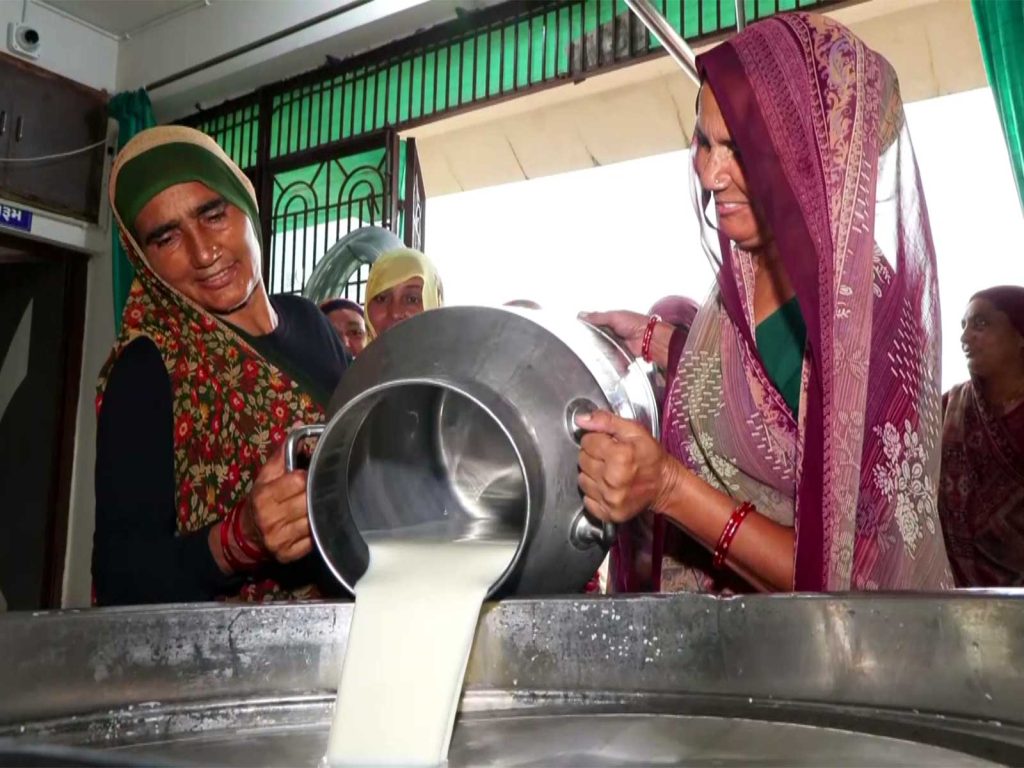
In Banaskantha district, home to Asia’s largest single milk-procurement union, Banas Dairy (Banaskantha District Co-operative Milk Producers’ Union), grassroots operations illustrate the modern technical management of these female-run units. At the Harsiddhnagar Mahila Doodh Utpadak Sahakari Mandali, women members handle the complete daily workflow: computerized intake, fat and SNF testing using digital analyzers, and chilling logistics for approximately 2,000 litres of milk delivered daily to Banas Dairy. Cooperative secretary Leelaben Chaudhary noted that digital payment systems and automated testing provide total transparency, encouraging higher local member participation.
The institutional formalization of women’s dairy leadership has also removed social and physical friction points that historically limited rural market access. Local dairy farmers reported that establishing decentralized, women-managed village societies eliminated the need to travel long distances to distant commercial collection centers. Furthermore, nearly 80,000 women have been elected or appointed to administrative committees and management boards of primary dairy cooperatives across Gujarat, participating directly in balance-sheet auditing, feed procurement, and cooperative governance.
The growing prominence of women in cooperative leadership directly aligns with national policy directives aimed at modernizing India’s primary agricultural credit and dairy societies (PACS). Ramilaben Chaudhary, board member of Banas Dairy—which procures over one crore (10 million) litres of milk daily and directs bank transfers to 1.98 lakh female suppliers—highlighted that direct electronic payments to women’s bank accounts have built genuine household financial independence. Institutionalizing women-led dairy cooperatives provides a proven structural model for rural socio-economic empowerment and sustainable milk pool expansion.
Source: ANI News
You can now read the most important #news on #eDairyNews #Whatsapp channels!!!
eDairy News ÍNDIA: https://whatsapp.com/channel/0029VaPidCcGpLHImBQk6x1F