



India stands as the undisputed titan of the dairy world, yet its footprint in the international marketplace is remarkably faint. Currently, the nation produces approximately 230 million tons of milk annually—a staggering 25% of the global supply.
However, this domestic “White Revolution” remains largely trapped within its own borders, with India commanding less than 1% of global dairy exports.
The central paradox is clear: How can a nation produce a quarter of the world’s milk and remain a minimalist in global trade? To understand this, we must look beyond the volume and interrogate a system designed for survival rather than export dominance.
The Great Milk Mismatch: A Statistical Overview
The gap between India’s production scale and its export relevance is stark when contrasted with the New Zealand model, which prioritizes global capture over domestic consumption.
| Metric | India (National Model) | New Zealand (Fonterra Model) |
| Share of Global Production | 25% | Surplus Self-Sufficient |
| Share of Global Export | < 1% | 95% of production |
| Primary Objective | Socio-economic safety net | Profit maximization/Export |
| Consumer Reach | 80% served directly by rural farmers | B2B (Bakeries, Fast Food, Restaurants) |
The fundamental question persists: Why has the momentum of India’s dairy success failed to cross its borders?
The Foundation: Operation Flood and the Socio-Economic Safety Net
The modern Indian dairy landscape was forged on January 13, 1970, with the launch of “Operation Flood.” Under the vision of Dr. Verghese Kurien—the “Father of the White Revolution”—India transformed from a milk-deficient state into a self-sufficient powerhouse.
Rather than adopting a corporate, top-down structure, Kurien implemented a Three-Tier Cooperative Model:
- Village Level: Primary societies where local farmers pool their daily yields.
- District Level: Unions responsible for local processing and logistics.
- State Level: Federations that manage brand marketing and wide-scale distribution.
This system was never intended to be a profit-maximizing machine for global trade. Instead, it serves as a socio-economic safety net for 80 million rural families. In a country where 80% of consumers are served directly by rural farmers, dairy is less of a commodity and more of a “rural lifeline,” providing essential daily cash income and nutrition.
The Invisible Backbone: A Lifeline in the Pail
FEATURE: The Rural Entrepreneur
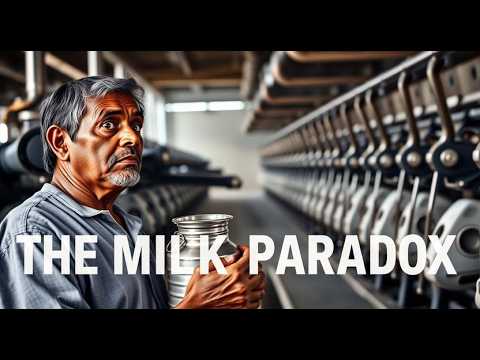
While the economics of milk are often discussed in tons and percentages, the heart of the industry is found in the hands of the Indian woman. Managing 70% of day-to-day dairy operations, these women are the invisible engineers of the rural economy. From the meticulous task of cattle feeding and providing first aid to managing the logistics of local milk pooling, they have turned back-breaking labor into a form of rural entrepreneurship.
The global theme of World Milk Day (June 1) has increasingly focused on celebrating women in farming, reflecting this Indian reality. For 80 million families, the evening’s milk collection is not just a trade statistic; it is the difference between poverty and stability. This “human-interest” success story explains why India’s model remains fiercely domestic: the priority is feeding the family and the village, not the global market.
India vs. New Zealand: Corporate Engineering vs. Rural Scale
While India focuses on its rural lifeline, New Zealand’s Fonterra has mastered a “corporate export strategy” designed to bypass retail competition entirely. Because New Zealand’s domestic market is tiny, it is forced to export 95% of its production.
Fonterra’s competitive edge is built on high-tech processing and strategic market placement:
- Industrial Specialization: They transform raw milk into high-margin pediatric nutritional bases, complex whey isolates, and specialized cheese proteins.
- Targeted Supply Chains: Rather than fighting for shelf space, they supply commercial bakeries, fast food chains, and restaurants across Asia.
- Engineered Products: They have developed “engineered cheese” specifically designed to tolerate high temperatures and withstand varied weather conditions during transport.
- Corporate Scale: By utilizing elite genetics and massive corporate scale, they achieve a level of efficiency that traditional Indian smallholders cannot match.
The Five Barriers to Global Export
As an investigative look into the industry reveals, India’s failure to export is not a matter of volume, but of structural and qualitative gaps.
1. The Yield Gap
There is a massive productivity chasm. International exporters utilize advanced machines, optimized feed, and climate-controlled ponds. Consequently, an average cow in those systems produces up to 10 times more milk per day than an Indian cow, drastically lowering the cost of production per liter and making Indian milk uncompetitive on price.
2. Quality Control and Contamination
This is the industry’s “black box.” While global leaders use automated milking systems—where milk flows from cow to refrigerated tanker without human contact—Indian milk involves significant human handling. This leads to higher bacteria counts and frequent rejections by the EU and US. More alarmingly, there is a “casual” attitude toward safety. The use of detergents as a cheaper alternative for processing is a “threat for our health,” yet the system lacks checks and balances. As one observer noted, there are “chemists in every corner” facilitating adulteration, suggesting that for many, quality does not matter as long as the quantity fulfills immediate needs.
3. The Source Mismatch
The global dairy market is built almost exclusively around cow’s milk. India’s production is a blend of cow and buffalo milk. While indistinguishable to the Indian consumer, the international market remains skeptical of buffalo-sourced products, creating a significant barrier to entry.
4. Product Type Mismatch
Global trade is dominated by high-margin processed goods like cheese, infant formula, and whey protein. In contrast, 85% of India’s milk is sold in its raw or liquid form. India focuses on traditional items like ghee, butter, and skimmed milk powder, while cheese—the darling of the global market—is the least focused item in the Indian portfolio.
5. Infrastructure and Waste
The logistical drain is immense. India loses roughly 3% of its total milk production annually—approximately 6.3 million tons—due to poor cold storage and a fragmented export network. This waste alone exceeds the entire production of many smaller dairy nations.
Conclusion: Quantity vs. Quality
India’s dairy journey is a monumental success in self-sufficiency, but it has reached a fork in the road. For decades, the priority has been quantity—fulfilling the needs of millions and providing a livelihood for 80 million families. However, this has come at the cost of the rigorous sanitary standards and high-tech processing required for global competition.
As it stands, India is a surplus, self-sufficient producer that functions as a socio-economic stabilizer. The question for the next phase of the White Revolution is whether India is willing to sacrifice its “casual” approach to quality and its traditional “rural lifeline” model to become a high-tech corporate exporter, or if being the world’s largest domestic provider is enough.
You can now read the most important #news on #eDairyNews #Whatsapp channels!!!
eDairy News ÍNDIA: https://whatsapp.com/channel/0029VaPidCcGpLHImBQk6x1F