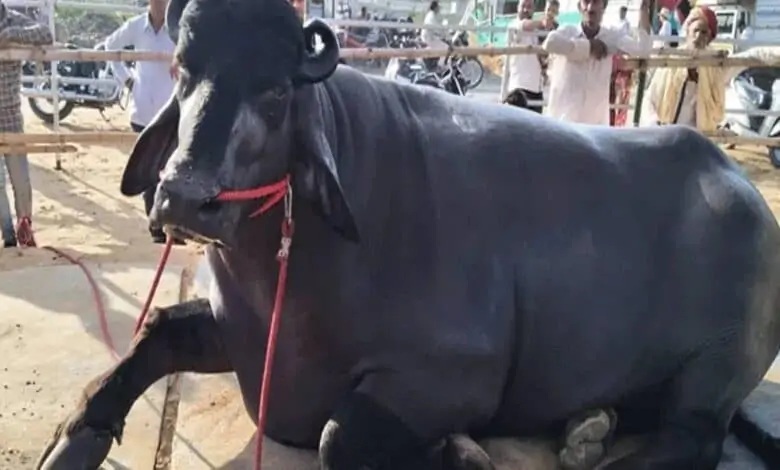



Rising carabeef realizations and culling returns of ~₹50,000 per animal provide essential cash flow for herd replacement and high-fat milk supply.
India’s buffalo meat (carabeef) export sector has reached a historic benchmark, expanding 25.6 percent in FY2025–26 to reach $5.1 billion, with government projections on track to cross $6 billion in FY2026–27. According to data from the Ministry of Commerce and Industry and the Agricultural and Processed Food Products Export Development Authority (APEDA), the sector’s rapid growth has been driven by market diversification and rising unit export realizations, which increased from $3,236 per metric tonne in FY2024–25 to $3,591 in FY2025–26, and climbed further to $4,392/tonne during the April–June 2026 quarter.
Crucially, the booming export trade operates as an essential economic pillar supporting India’s domestic dairy production system. Unlike beef-producing nations where cattle compete directly with dairy herds for pasture and feed resources, Indian livestock laws prohibit the slaughter of cows, and male or female dairy buffaloes are not reared primarily for meat. Instead, carabeef exports are sourced exclusively from animals that have become economically unproductive—including low-yielding or aging buffaloes, infertile females, animals with damaged udders, and surplus male calves.
Providing a legal, regulated salvage value for end-of-life livestock directly improves the balance sheets of smallholder dairy producers. When a milking buffalo reaches the end of its productive cycle, dairy farmers can realize approximately ₹50,000 (roughly $600 USD) by culling the animal through APEDA-registered abattoirs. This capital recovery enables producers to quickly reinvest in younger, higher-yielding heifers, accelerating genetic turnover and sustaining herd productivity across India’s 110-million-strong buffalo population.
This financial cycle is reinforcing the supply of high-fat raw milk required by India’s expanding dairy processing industry. Former GCMMF (Amul) Managing Director R.S. Sodhi noted that consumer demand for fat-intensive dairy products—such as ghee, paneer, cream, butter, and khoya-based sweets—is driving dairy processors in key belts like Uttar Pradesh to offer farmgate procurement rates of ₹880 to ₹920 per kilogram of fat, yielding an average realization of ₹60 per litre for raw buffalo milk. The combination of remunerative milk prices and terminal livestock salvage values makes buffalo dairying financially sustainable for rural households.
On the global stage, Indian exporters—led by major processing houses such as Allanasons, Fair Exports India, and HMA Agro Industries—are successfully shifting buffalo meat from an industrial commodity ingredient into a recognized global protein brand. While traditional Asian and Middle Eastern destinations like Vietnam, Malaysia, Egypt, Saudi Arabia, and the UAE remain core buyers importing over $100 million each, Indian carabeef is expanding into new markets across Central Asia, Eastern Europe, and Africa, including Uzbekistan, Russia, Georgia, and Senegal. This sustained global demand provides continuous price support across India’s rural livestock economy.
Source: The Siasat Daily / The Indian Express
You can now read the most important #news on #eDairyNews #Whatsapp channels!!!
eDairy News ÍNDIA: https://whatsapp.com/channel/0029VaPidCcGpLHImBQk6x1F