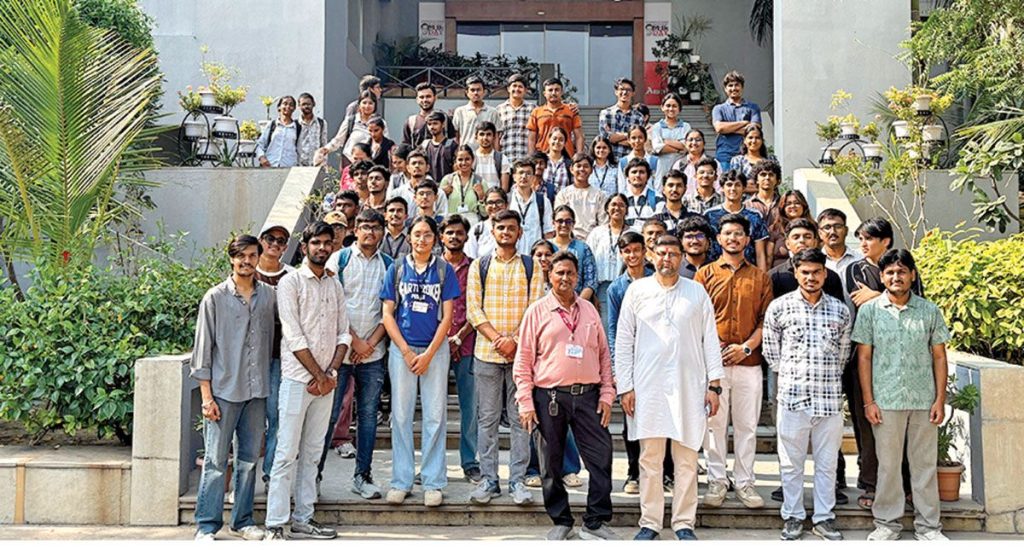




Technical cohorts analyze industrial dairy automation and power electronics during an on-site operational study of large-scale milk manufacturing.
A specialized delegation of power electronics engineering students from Vishwakarma Government Engineering College completed an intensive industrial technical visit to the AmulFed Dairy manufacturing complex in Gujarat, gaining direct exposure to commercial automation systems. The facility represents one of the largest integrated dairy manufacturing complexes in Asia, engineered to process upwards of five million liters of raw milk per day into diversified liquid milk, skim milk powder, and dairy whitener product lines. Under the academic supervision of institutional leadership and departmental faculty, the technical visit provided engineering scholars with practical insight into the continuous journey of raw milk from farmgate tanker reception to automated retail dispatch. Operating at this massive throughput volume requires continuous process optimization and stringent electrical infrastructure to maintain product integrity and prevent costly processing downtime. Examining these industrial operations allowed the engineering cohort to observe how large-scale dairy processors deploy modern electrical hardware to manage high-volume manufacturing lines efficiently.
From an engineering perspective, modern fluid dairy manufacturing relies on a sophisticated array of electrical and mechanical systems to ensure food safety and process reliability. The students tracked intake operations through high-speed automated receiving bays where computerized testing systems instantly determine milk butterfat and solids-not-fat parameters before raw supplies are routed into bulk storage silos. Processing circuits utilize advanced variable frequency drives, motor control centers, programmable logic controllers, and supervisory control and data acquisition architectures to regulate pumps, homogenizers, centrifugal clarifiers, and plate pasteurizers. These integrated control systems modulate motor speeds in real time to match fluctuating liquid volumes, minimizing thermal stress on delicate dairy proteins and reducing auxiliary electrical consumption. Furthermore, clean-in-place installations rely on automated valve matrices and electronic flow meters to cycle sanitizing solutions through stainless steel conduits without requiring manual disassembly.
The deployment of automated process controls reflects an ongoing modernization drive across the broader Indian dairy manufacturing landscape as cooperatives transition toward Industry 4.0 standards. Meeting the nutritional demands of expanding urban markets has compelled major dairy federations to move away from semi-manual production methods in favor of fully enclosed, digitally monitored processing corridors. Implementing closed-loop automation minimizes human contact with dairy products during sensitive phases such as aseptic packaging and spray drying, directly suppressing microbial contamination and extending product shelf life. In specialized powder drying towers, computerized airflow dampers and temperature controllers maintain consistent moisture evacuation to produce uniform bulk powder densities suitable for global export specifications. By standardizing manufacturing metrics through digital telemetry, processing plants achieve predictable production yields while capturing higher operating margins across packaged value-added consumer verticals.
On the corporate balance sheet, investing in capital-intensive automation equipment delivers tangible operational expenditure efficiencies that protect cooperative finances. Electrical energy and boiler fuel represent two of the largest recurring operating costs in high-throughput dairy processing, second only to farmgate milk procurement expenses. Installing energy-efficient power electronic converters, premium-efficiency induction motors, and automated peak-load shaving systems significantly curtails kilowatt-hour consumption per metric ton of milk processed. Furthermore, high-speed automated packaging machinery equipped with digital weight checkers drastically reduces product giveaway and film wastage, preserving millions of rupees in operational margins over sustained production runs. While initial capital expenditure outlays for advanced instrumentation and industrial fieldbuses remain substantial, the resulting reduction in batch cycle times and emergency equipment breakdowns delivers rapid capital payback for processing federations.
Developing specialized engineering talent capable of maintaining complex electromechanical hardware remains essential for safeguarding long-term supply chain resilience across the dairy sector. As modern processing complexes incorporate artificial intelligence, predictive vibration analysis, and industrial internet-of-things sensors, the operational interface between traditional food science and power electronics continues to tighten. Technical training initiatives that bridge collegiate electrical curricula with physical manufacturing plants ensure a dependable pipeline of skilled engineers capable of troubleshooting high-voltage distribution networks and automated control loops. Sustaining high plant reliability and avoiding unplanned shutdowns directly protects the economic interests of hundreds of thousands of smallholder dairy producers who depend on daily cooperative milk collections. Integrating advanced automation with robust engineering oversight will remain vital to keeping Indian dairy manufacturing globally competitive and economically sustainable for future decades.
Source: Vishwakarma Government Engineering College
You can now read the most important #news on #eDairyNews #Whatsapp channels!!!
🇮🇳 eDairy News ÍNDIA: https://whatsapp.com/channel/0029VaPidCcGpLHImBQk6x1F