

India’s solar milk chillers are demonstrating how renewable energy can strengthen dairy supply chains while creating new economic opportunities for women in rural communities.
Across drought-prone districts in Maharashtra’s Marathwada region, 100 solar-powered bulk milk chillers (BMCs) now allow milk to be collected, cooled and stored within villages before being transported to dairies. The decentralized system reduces spoilage, lowers transportation needs and enables thousands of women to participate more directly in dairy marketing and income generation.
The initiative, implemented by Swayam Shikshan Prayog (SSP) through three Farmer Producer Companies (FPOs), currently benefits approximately 3,000 to 3,500 women across 100 villages in Dharashiv and Latur districts.
For many households, the infrastructure has fundamentally changed how milk reaches the market.
Previously, farmers often had to transport fresh milk immediately to distant collection centres because high temperatures could quickly reduce quality. Without refrigeration at home, delays frequently resulted in lower prices or spoilage.
Today, village-level chilling allows milk from both morning and evening milking sessions to be stored safely before collection, reducing time pressure on producers while improving the reliability of milk marketing.
The model has also shifted financial control within many households.
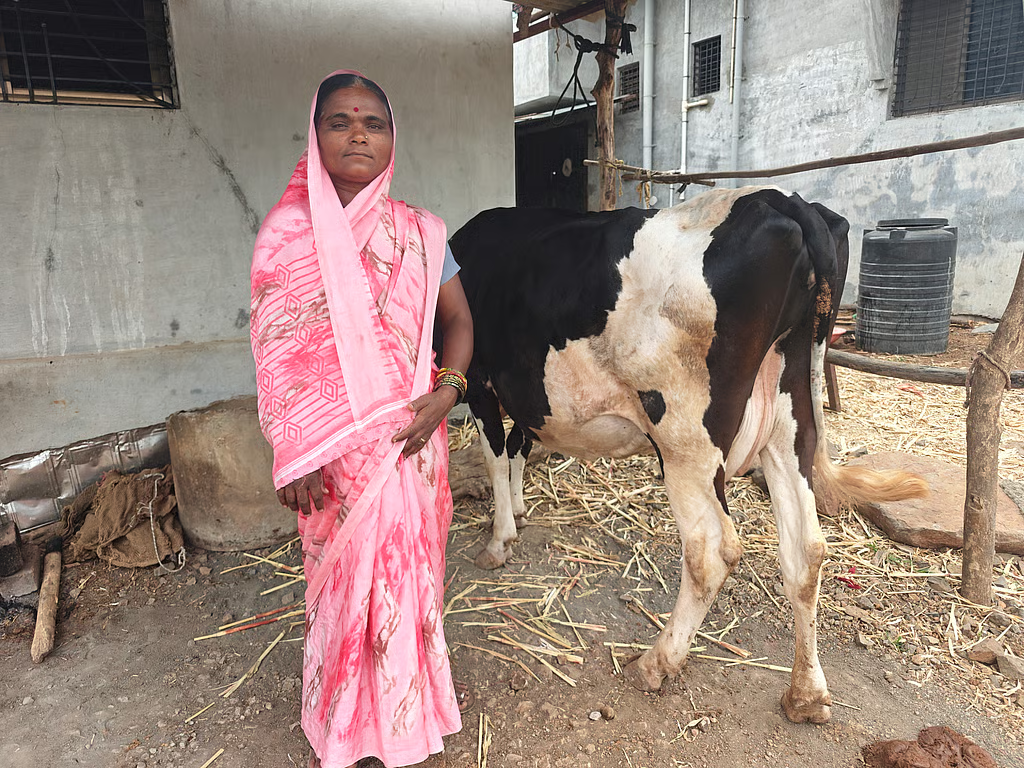
Women who traditionally cared for livestock but relied on family members to deliver milk are increasingly managing sales themselves, with payments transferred directly into their bank accounts through digital systems linked to the village collection centres.
At each collection point, milk is weighed, tested for quality and recorded through a mobile application that automatically calculates payment based on fat content and volume. Producers receive digital confirmation of the transaction, while payments are deposited every ten days.
Beyond improving access to markets, the solar-powered system is also contributing to lower operating costs and reduced greenhouse gas emissions.
According to the World Wide Fund for Nature (WWF), the dairy cold chain is the second-largest source of carbon dioxide emissions within dairy operations, while cooling and chilling account for approximately 25% to 30% of total dairy energy consumption.
India is currently mapping the carbon footprint of its dairy sector through work led by The Energy and Resources Institute (TERI) and the National Dairy Development Board (NDDB) as the country works toward its target of achieving net-zero emissions by 2070.
Within the Maharashtra project, each village BMC is powered by a 3-kilowatt solar system and has the capacity to store 250 litres of milk.
Together, the network collects an average of 13,500 litres of milk every day, with each centre typically serving around 40 women dairy farmers who deliver milk twice daily.
The environmental benefits extend beyond renewable electricity.
Because chilled milk from evening and morning collections can be transported together, collection vehicles now visit participating villages once per day instead of twice. According to SSP, this reduces transportation requirements across the network while lowering fuel consumption and emissions.
The organization estimates that a 1,000-litre solar bulk milk chiller can reduce approximately six tonnes of CO₂ emissions annually. Across its network of 100 smaller 250-litre units, annual savings are estimated at around 150 tonnes of CO₂.
Reduced transportation also contributes additional environmental gains. According to the project, fewer collection trips save at least 100 tonnes of CO₂ emissions annually, while local transport operators report significant reductions in daily diesel consumption.
Solar energy is also improving operational reliability in villages where electricity supply remains inconsistent.
Frequent power outages previously forced operators to transport milk immediately or rely on diesel generators to keep cooling equipment operating. Solar-powered systems now allow milk to remain safely chilled for up to 24 hours, reducing dependence on backup generators while maintaining milk quality.
The initiative illustrates how investments in decentralized dairy infrastructure can simultaneously address multiple challenges facing India’s dairy sector, including cold-chain efficiency, renewable energy adoption, rural livelihoods and women’s economic participation.
The broader context reinforces the importance of such solutions.
Maharashtra produces approximately 16 million tonnes of milk annually, contributing 6.7% of India’s total milk production. Around 7.5 million households participate in dairy farming across the state, while women perform approximately 70% of livestock management activities.
Many of these households rely on small dairy herds as a critical source of income, particularly in regions where climate variability, water scarcity and declining agricultural employment have reduced alternative livelihood opportunities.
For researchers and industry experts, the Maharashtra experience demonstrates that village-level solar chilling can deliver benefits that extend beyond energy savings. By improving milk preservation, strengthening local collection systems and increasing women’s control over dairy income, renewable-powered cold storage is emerging as an important component of India’s evolving dairy value chain.
Produced by eDairyNews, with information published by downtoearth.