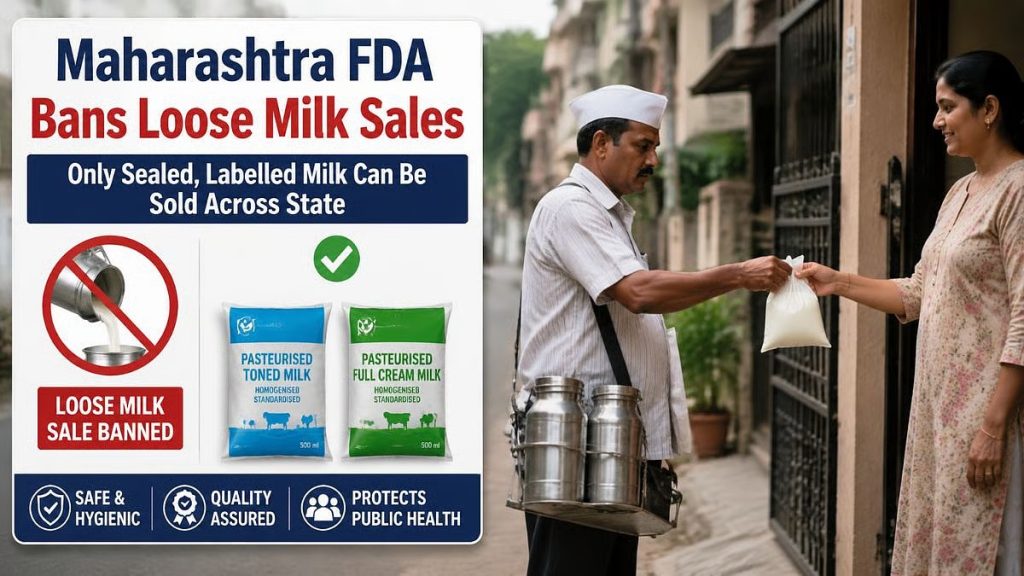




Food Safety Commissioner Tukaram Mundhe enforces a complete ban on unsealed milk, hitting thousands of retailers with hefty fines.
The Maharashtra Food and Drug Administration (FDA) has enforced an immediate, statewide ban on the sale of loose milk, requiring all liquid varieties to be distributed strictly in sealed, labeled, and tamper-evident packaging. Enforced by Food Safety Commissioner Tukaram Mundhe through an order dated July 3, 2026, the sweeping measure has forced thousands of traditional milk retailers and “doodhwalas” to immediately halt operations. Non-compliant vendors face a massive statutory penalty of Rs 3 lakh, causing hundreds of local shops to down shutters and triggering significant immediate job losses across regional supply lines.
The sudden regulatory intervention stems from deep-tier food safety concerns across India’s domestic supply chain. Official inspections conducted by the FDA exposed a widespread and consistent lack of compliance among informal operators. Furthermore, data from the National Milk Safety and Quality Survey, orchestrated by the Food Safety and Standards Authority of India (FSSAI), highlighted severe milk contamination risks. Specifically, the watchdog flagged critical public health threats arising from antibiotic residues and Aflatoxin M1, a dangerous compound originating from contaminated animal feed and fodder.
The sweeping transition has triggered immense friction among independent milk traders, wholesalers, and bulk downstream processing sectors. Setting up an authorized milk pasteurization and packaging facility requires an estimated capital expenditure upwards of Rs 12 crore, a financial hurdle that remains entirely unviable for small-scale family businesses. Consequently, independent vendors across major municipal hubs have completely closed down local distribution networks, sparking intense pushback from consumer advocacy cohorts who note that packaged alternatives will inevitably increase household grocery expenses.
Beyond everyday households, the operational ban heavily threatens the raw material access and profit margins of commercial bulk buyers, including regional sweet shops and ice-cream parlours. Babu Chodankar, secretary of the Thane Sahar Doodh Vyavasi Cooperative Society (TSDVCS), confirmed that all member retail operations involving loose milk cans or direct home delivery were forced to stop by Friday. Commercial food processors heavily relied on these informal channels because unsealed milk supplies were significantly easier to process on-site and retailed between Rs 2 to Rs 4 cheaper per litre compared to pre-packaged corporate alternatives.
The scale of the market disruption is amplified by the massive daily liquid milk requirements of urban centers like Mumbai, which demands 50 lakh litres daily, and the broader Mumbai Metropolitan Region (MMR), which consumes nearly 60 lakh litres every single day. Historically, unorganized wholesalers and local retailers accounted for at least 35 percent of this entire regional supply matrix, drawing heavily from major production basins like Kolhapur, Satara, Nashik, Pune, and Sangli. This massive regulatory shift effectively mandates a total structural reorganization of regional dairy distribution, forcing informal traders to either exit the market or absorb costly modern processing infrastructure.
Source: The Free Press Journal
You can now read the most important #news on #eDairyNews #Whatsapp channels!!!
eDairy News ÍNDIA: https://whatsapp.com/channel/0029VaPidCcGpLHImBQk6x1F