

Chief Minister Mohan Yadav orders statewide ban as food safety officials seize 450 kg of synthetic substitute in Indore.
The Government of Madhya Pradesh has announced a complete statewide prohibition on the manufacture, distribution, and sale of analogue (non-dairy) paneer, reinforcing its commitment to protecting natural dairy supply chains and public health. Chief Minister Mohan Yadav issued the directive during a high-level review with the Food and Civil Supplies Department, instructing enforcement agencies to execute immediate inspections of suspected processing units. The decision positions Madhya Pradesh as the fourth major Indian state—following Maharashtra, Gujarat, and Chhattisgarh—to formally ban imitation paneer products.
Analogue paneer is manufactured as a low-cost substitute for natural milk cheese, replacing milk solids and butterfat with vegetable oils, hydrogenated fats, and starches. While natural milk paneer retails across urban centers at ₹450 to ₹470 per kilogram, synthetic alternatives trade at ₹200 to ₹220 per kilogram, driving rapid uptake among institutional caterers, hotels, and restaurants. State Food Safety Department estimates indicate that monthly consumption of analogue paneer in Madhya Pradesh reached 9,000 to 14,000 quintals, undercutting farmgate milk pricing and diverting revenues away from primary dairy producers.
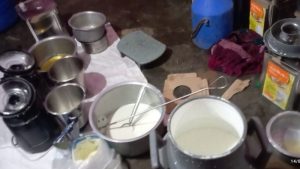
Enforcement action commenced immediately following the executive announcement, with a Food and Safety Department task force raiding a manufacturing unit in Indore and seizing 450 kilograms of illicit analogue paneer. District food safety officers across all administrative divisions have been empowered to conduct surprise raids, impound raw material stocks, and suspend operating licenses of non-compliant facilities. The policy initiative aligns with recent warnings from the National Human Rights Commission (NHRC) regarding the hazardous health impacts of unregulated vegetable-fat dairy substitutes.
State leadership emphasized that the prohibition forms part of a broader strategy to boost regional milk production and preserve the economic viability of traditional livestock rearing. By prohibiting mislabeled synthetic blocks from entering commercial food service channels, state authorities aim to restore raw milk demand and support cooperative procurement networks. Officials noted that surrounding states’ bans created a heightened risk of illicit analogue dumping, making unified regional enforcement essential to maintaining market integrity across central India.
The regulatory crackdown reflects a broader policy trend across India’s primary dairy producing regions, prioritizing supply chain transparency and farmgate value protection. For commercial processors and food service operators, the elimination of cheap non-dairy alternatives mandates a structural shift back to genuine milk-derived inputs. As regional enforcement task forces expand testing protocols, state-level bans on imitation dairy products serve to insulate primary producers from synthetic substitution while reinforcing consumer trust in natural milk value chains.
Source: Deccan Chronicle
You can now read the most important #news on #eDairyNews #Whatsapp channels!!!
eDairy News ÍNDIA: https://whatsapp.com/channel/0029VaPidCcGpLHImBQk6x1F