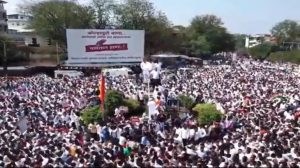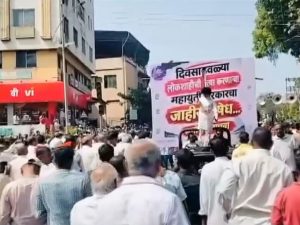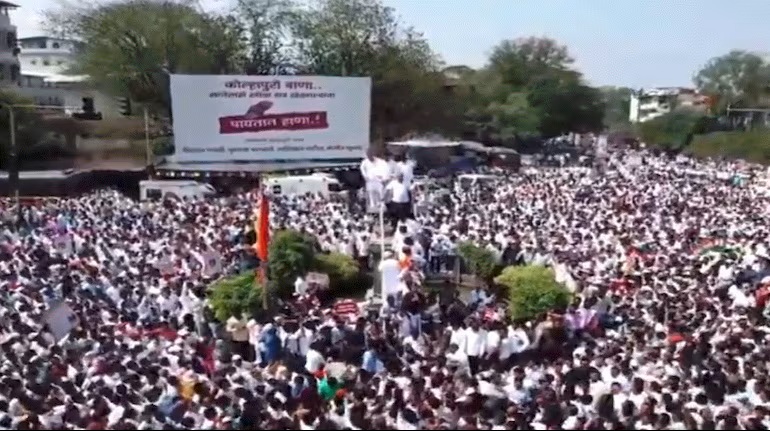



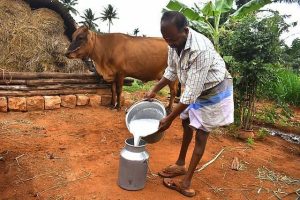
Senior opposition leadership steps up allegations against the Maharashtra government, charging that the cabinet ordinance amending the Cooperative Societies Act was explicitly engineered to overturn a democratic mandate won by 5.5 lakh milk producers.
The high-stakes political clash over western Maharashtra’s premier dairy cooperative has intensified, with the Congress leadership leveling direct accusations against the Devendra Fadnavis-led Maharashtra government for manipulating statutory rules to seize administrative control of the Kolhapur District Cooperative Milk Producers’ Union (Gokul Dairy). As reported in ongoing national and state dispatches, the opposition argues that the ruling Mahayuti coalition utilized state executive powers to circumvent the outcome of the October board elections, where the opposition-backed alliance secured an outright majority.
At the core of the political storm is the state cabinet’s emergency amendment to the Maharashtra Cooperative Societies Act, 1960, enacted on November 4. The ordinance allows the state government to appoint five nominated directors to the governing boards of cooperative institutions boasting an annual turnover in excess of ₹500 crore. Critically, four of these five nominees are granted full voting rights in internal board elections, including the selection of the union chairperson.
Congress leaders and farm representatives argue that the timeline reveals clear political motivation:
-
Subverting Board Arithmetic: In the October 19 elections for Gokul’s 25-member board, the Congress-led Rajarshi Shahu Shetkari Samvichari Aghadi (spearheaded by Satej “Bunty” Patil) won 13 seats, while the BJP-led Mahayuti coalition secured 12. By introducing four voting nominees, the government effectively alters the voting balance from 13–12 in favor of the opposition to a potential 16–13 advantage for the ruling alliance.
Engineered Quorum Standoff: Under Gokul’s bylaws, electing the board chairperson requires a minimum quorum of 14 directors. On October 29, all 12 Mahayuti directors boycotted the scheduled election meeting, leaving the 13 elected majority members one director short of the statutory requirement. Opposition leaders argue this abstention was deliberately orchestrated to fabricate a statutory “crisis” and justify executive intervention under the guise of preventing an administrative takeover by the District Deputy Registrar (DDR).
High Court Legal Intervention: Following massive farmer mobilizations under the Sangharsh Morcha and legal petitions challenging the constitutionality of the ordinance, the Bombay High Court permitted the November 10 election meeting to proceed under mandatory videography, but ordered the ballots of the four government-appointed voting nominees to be placed in a sealed cover, making the final result contingent on the court’s upcoming hearing on November 25, 2026.
From an agribusiness governance and cooperative law perspective, the dispute over Gokul Dairy—an enterprise generating over ₹4,000 crore in annual turnover and procuring milk from more than 5.5 lakh rural households—highlights the vulnerability of wealthy producer-owned cooperatives to executive encroachment. Allowing government appointees to vote alongside elected representatives risks undermining the constitutional autonomy granted to agricultural cooperatives under the 97th Constitutional Amendment, establishing a precedent that could destabilize cooperative boards across India’s dairy and sugar belts.
Maharashtra Cooperative Governance Row
Gokul Dairy Power Struggle: Ordinance vs. Mandate
Electoral arithmetic, state intervention criteria, and judicial review timeline.
Elected Majority
13 Seats
Samvichari Aghadi (Patil)
State Intervention
4 Voting Seats
Appointed via ordinance
Judicial Hearing
Nov 25, 2026
Bombay High Court
Gokul Board Power Balance
Elected Outcome vs Ordinance Shift
Elected Outcome vs Ordinance Shift
Elected Opposition (Samvichari Aghadi):
13 Directors (Elected Majority)
13 Directors (Elected Majority)
Mahayuti Coalition (12 Elected + 4 Nominees):
16 Voting Members (Ordinance Advantage)
16 Voting Members (Ordinance Advantage)
Key Opposition Arguments & Legal Safeguards
Allegation of Post-Election Rule Changes
Congress asserts that amending the Cooperative Societies Act specifically for ₹500-crore entities after losing the election represents a direct attempt to overturn a democratic producer vote.
Boycott-Induced Quorum Deficit
The opposition claims the absence of 12 Mahayuti directors on Oct 29 was coordinated to block the 14-member quorum and manufacture a pretext for state intervention.
High Court Sealed Ballot Protection
While the election was allowed to proceed on Nov 10, the Bombay High Court required that votes from the four government nominees be sealed, leaving the ultimate result subject to final review on Nov 25.
Entity: Kolhapur District Milk Union (Gokul Dairy)
₹4,000 Cr Cooperative
₹4,000 Cr Cooperative
Source: Regional Agricultural & Legal Dispatches
eDairyNews India Cooperative Intelligence
eDairyNews India Cooperative Intelligence
Source: Moneycontrol
You can now read the most important #news on #eDairyNews #Whatsapp channels!!!
🇮🇳 eDairy News ÍNDIA: https://whatsapp.com/channel/0029VaPidCcGpLHImBQk6x1F