



Higher prices, tighter rules and an uncomfortable truth for the industry: without compliance, there is no market
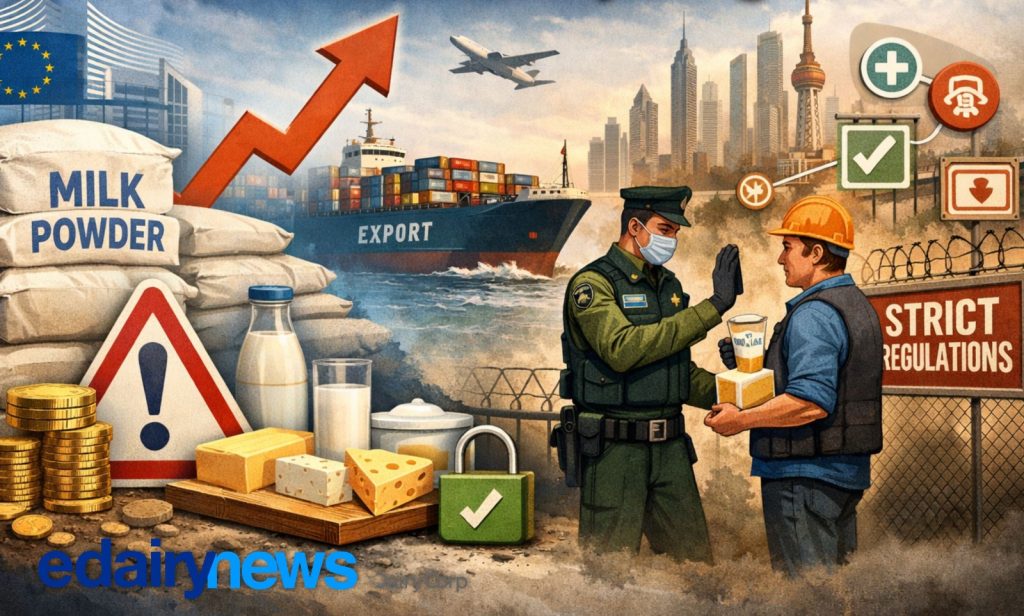
The start of 2026 has delivered a signal the global dairy industry cannot afford to ignore. International prices have strengthened decisively. Milk powder values have moved above USD 3,300 per metric ton, even for lower-margin reference products, reshaping expectations across supply chains, balance sheets and policy agendas.
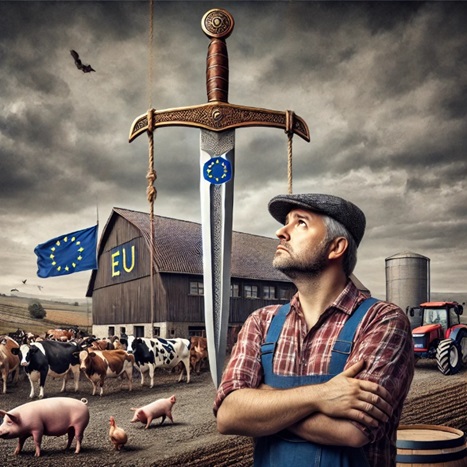
Yet the underlying message is far less comforting than it appears. Higher prices no longer buy tolerance. On the contrary, rising values are coinciding with higher entry barriers, redefining dairy trade at three inseparable levels: industrial, financial and political.
A Market That Improves — But Does Not Forgive
For years, weak prices served as an excuse for structural inefficiencies. When returns were low, gaps in productivity, delayed regulatory reforms and sanitary shortcomings were often rationalised as unavoidable constraints.
That narrative has now collapsed. The latest Global Dairy Trade rebound is not merely a technical correction. It reflects active demand, tighter availability and buyers increasingly willing to secure volumes amid geopolitical uncertainty. More importantly, it confirms that global dairy trade no longer tolerates ambiguity.
Mastellone and the Message the Industry Resists
Few voices express this reality more clearly than Flavio Mastellone, a senior executive and long-standing reference within the Argentine dairy industry:
“Higher prices do not change the fundamentals. There is no international demand for dairy products without full sanitary certification. Compliance is not optional — it is the entry ticket to value-added markets.”
This is not rhetoric. It is the perspective of an operator competing in regulated, competitive and increasingly unforgiving markets.
The End of ‘Tolerant’ Markets
For decades, certain regional destinations — Brazil being the most emblematic case — functioned as pressure valves for surplus production. Proximity and relatively flexible requirements allowed volumes to flow even when structural competitiveness was weak.
That model is fading. With supply expanding across producing regions and global prices strengthening independently of regional demand, reliance on a single outlet has shifted from strategy to vulnerability. Global trade now demands diversification, predictability and compliance.
Mercosur: A Debate That Can No Longer Be Delayed
The discussion around Mercosur’s Common External Tariff, currently set at 28% for dairy products, exposes a deeper political dilemma. In a world where average tariffs are significantly lower, excessive protection increasingly clashes with the need for global competitiveness.
Reducing barriers implies greater competition — but also forces a long-overdue industrial transformation. The question is no longer ideological. It is strategic: is the sector prepared to operate under global rules, or not?
Europe and Asia: Different Regions, Same Requirement
In the European Union, sanitary compliance, traceability and certification are not debated — they are assumed. The challenge lies in margins, efficiency and managing supply growth.
Asia, meanwhile, remains the primary engine of global demand. But it is a highly professionalised demand. Buyers pay premiums, but only where quality, consistency and sanitary guarantees are unquestionable.
In both cases, the conclusion converges: market access has become binary.
Industry, Finance and Politics: One Equation
This new phase exposes an uncomfortable reality. Producing more is not enough. Price recovery does not compensate for structural weaknesses. Global dairy trade requires investment, financial discipline, regulatory alignment and coherent policy decisions.
Strong prices offer an opportunity — but also a test. Those who fail to use this window to align with international standards risk being confined to low-value markets precisely when global demand is recovering.
Conclusion: Less Narrative, More Access
The signal from the market is unmistakable. It pays more, but demands more. Sanitary standards are non-negotiable. Traceability is mandatory. Delays are punished.
In today’s dairy trade, competitiveness is measured not only in tonnes or prices, but in credibility. And credibility, once lost, is far harder to rebuild than capacity.
The world is ready to buy.
The question is who is truly ready to sell.
Valeria Hamann
EDAIRYNEWS
You can now read the most important #news on #eDairyNews #Whatsapp channels!!!
🇮🇳 eDairy News ÍNDIA: https://whatsapp.com/channel/0029VaPidCcGpLHImBQk6x1F