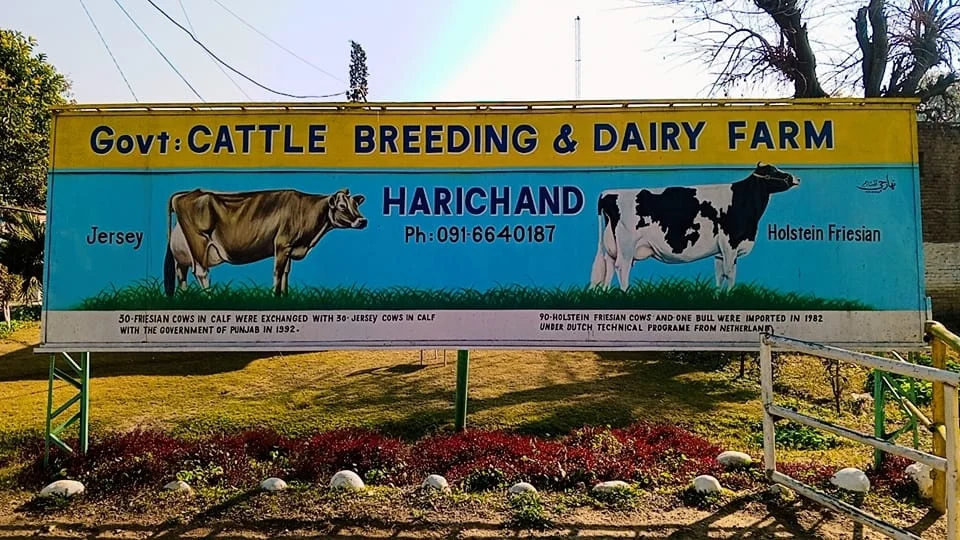



Harichand cattle farm has been placed under formal investigation after senior officials from the Khyber Pakhtunkhwa livestock department uncovered what they described as serious administrative and operational irregularities during a recent inspection in Charsadda district.
According to department sources, the probe was ordered on Monday by Livestock Secretary Zareeful Mani following his review of a report prepared after a visit to the government-owned breeding and dairy facility. The farm, which spreads across more than 500 acres, is intended to function as a flagship center for cattle breeding, milk production, and semen processing for the province.
Officials involved in the inspection said the facility was found to be operating far below expected standards, with issues ranging from proxy attendance and incomplete milk production data to widespread lapses in cleanliness and biosecurity. The findings prompted the immediate formation of a fact-finding committee to establish accountability and recommend corrective action.
The three-member committee is headed by Deputy Secretary Ishaq Ahmad, with Dr Habibur Rehman, director of poultry health and production, and Senior Research Officer Dr Hameedullah serving as members. Their mandate includes auditing administrative and financial records, identifying procedural failures, and proposing both short- and long-term reforms to bring the farm back on track.
People familiar with the inspection said the scale of the problems raised alarms at the highest levels of the department. During the visit, only two out of the 40 staff members officially assigned to cleanliness duties were present on site. Inspectors also reported multiple cases of proxy attendance, as well as suspected “ghost workers” whose names appeared on payrolls but who could not be physically verified.
In addition to staffing concerns, the committee was informed that several key project files were missing, creating obstacles to understanding how funds had been spent over recent years. Infrastructure across the farm was described as dilapidated, with cow sheds and feed processing areas in need of urgent repairs. The milking parlours were reportedly non-functional at the time of inspection, despite being a core component of the farm’s mandate.
Perhaps most troubling was the disappearance of a power generator valued at Rs5 million, which officials said could not be located or accounted for in existing records. The loss of such a major asset has raised questions about internal controls and inventory management at the facility.
The inspection report also challenged the credibility of reported milk production and sales figures. Auditors noted that there was no proper reconciliation between production data and revenue records, making it difficult to verify how much milk was actually being produced or sold. In the absence of reliable documentation, they said, the risk of misreporting or financial leakage could not be ruled out.
Beyond financial issues, the report pointed to serious risks to animal health. A lack of cleanliness, weak adherence to biosecurity protocols, and poor supervision were flagged as factors that could expose cattle to disease outbreaks, undermining both productivity and public confidence in the farm’s operations.
Following the inspection, Livestock Secretary Zareeful Mani directed farm management to take immediate corrective measures. These include improving sanitation across the facility, enforcing biosecurity rules, and introducing a digital attendance system to prevent proxy reporting and ensure that staff are physically present for duty.
Department officials said the fact-finding committee has been instructed to complete its work promptly and submit a detailed report with actionable recommendations. While no timeline has been publicly announced, insiders suggest that the findings could influence broader reforms across other government-owned livestock facilities in the province.
The Harichand cattle farm was established to support breeding programs, provide quality semen for artificial insemination, and serve as a model dairy unit for local farmers. However, critics within the department say that without strict oversight, the farm has gradually drifted from these objectives.
As the investigation moves forward, officials stress that the aim is not only to fix problems at a single facility, but also to strengthen governance across the entire livestock sector in Khyber Pakhtunkhwa. For now, the spotlight remains firmly on Harichand cattle farm, as authorities seek to determine how a project of such strategic importance was allowed to fall into disarray.
Written for eDairyNews, with information from: Daily Times