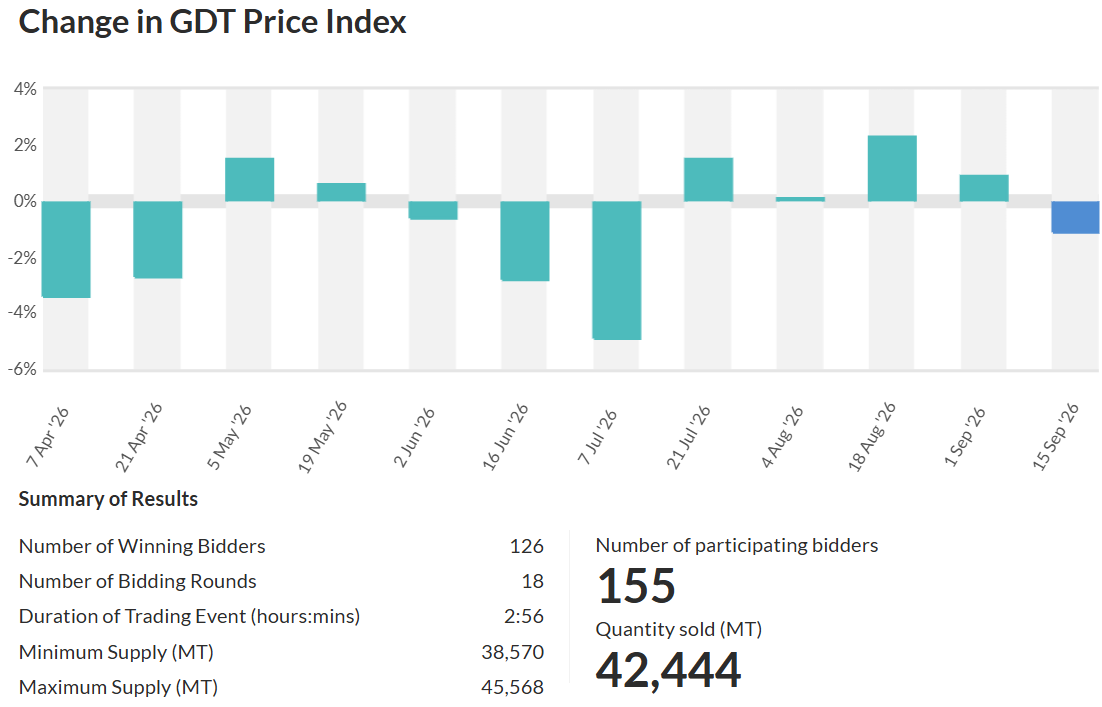




The global dairy market showed fresh signs of weakness once again. In the latest edition of the Global Dairy Trade (GDT), held on September 15, 2026, the price index fell 1.1% compared to the previous event, reinforcing a trend that worries both exporters and analysts in the agribusiness sector.
GDT is one of the most influential platforms worldwide for buying and selling dairy products, and its results often foreshadow movements in international prices for milk and its derivatives. That’s why every new edition is closely watched by governments, cooperatives, and exporting companies, especially in countries with a strong presence in dairy production.
This time, the average winning price stood at $3,868 per metric ton (USD/MT), a figure that reflects the downward adjustment recorded during the trading session. This value came out of a process that combined 18 bidding rounds and lasted 2 hours and 56 minutes, during which participants set their offers in real time.
The event brought together 155 participating bidders, of whom 126 came away as winners in at least one round of the auction. This ratio between participants and winners helps gauge the level of competition during the session, in a context where every percentage point of variation can directly impact producers’ income.
Regarding the volumes traded, the minimum supply available was 38,570 metric tons, while the maximum offered reached 45,568 metric tons. Finally, the quantity actually sold came in at 42,444 metric tons, a figure that falls within the offered range and confirms that a good portion of the available stock found a buyer despite the downward price environment.
Beyond this specific event’s outcome, the 1.1% drop adds to a landscape that industry players have been closely monitoring over recent editions. If this trend deepens in upcoming auctions, it could trigger adjustments in income projections for the dairy season and reopen the debate over the sustainability of margins across the entire global value chain.