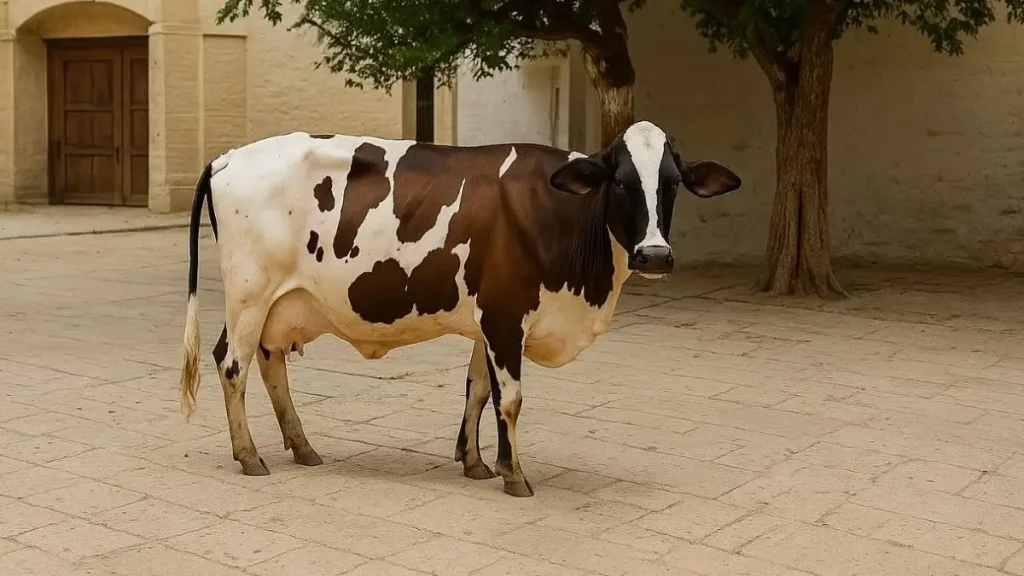




Karan Fries is fast becoming the symbol of India’s next dairy revolution, as scientists and policymakers highlight the synthetic cattle breed as a rare blend of high milk yield and climate resilience tailored for Indian conditions.
The breed recently received official registration from the Indian Council of Agricultural Research, marking a milestone in decades of scientific work carried out at the National Dairy Research Institute. During a public event hosted by ICAR–NBAGR, Agriculture Minister Shivraj Singh Chouhan handed over registration certificates to 16 new livestock and poultry breeds, including Karan Fries and Vrindavani, taking India’s total tally to 246 officially recognized breeds.
Officials familiar with the process said the registration is not merely symbolic. It formally acknowledges Karan Fries as a genetically stable breed, suitable for long-term dairy development strategies under the government’s Viksit Bharat vision.
Developed through systematic crossbreeding between the exotic Holstein Friesian and the indigenous Tharparkar, Karan Fries was designed to solve one of Indian dairying’s most persistent problems: how to achieve international-level productivity without sacrificing adaptability to tropical climates.
Scientists at ICAR–NDRI explained that early generations of crossbreeds often showed impressive output but struggled with heat stress, disease susceptibility and management challenges. Over multiple generations of inter se breeding, however, Karan Fries has reached genetic stability, showing uniformity in production traits and the ability to perform reliably under Indian farm conditions.
Performance data shared by researchers indicate that Karan Fries cows average about 3,550 kilograms of milk per 10-month lactation, or roughly 11.6 kilograms per day. Exceptional animals have produced as much as 5,851 kilograms in 305 days, with peak daily yields exceeding 46 kilograms.
These figures place the breed well above most indigenous cattle, which typically deliver between 1,000 and 2,000 kilograms per lactation, and even ahead of many exotic breeds that underperform when exposed to India’s hot and humid environment.
Officials involved in the breeding program said this balance between productivity and resilience is the breed’s defining strength. Tharparkar contributes heat tolerance, disease resistance and lower maintenance requirements, while Holstein Friesian genetics ensure the high milk output demanded by India’s growing dairy market.
Agriculture Ministry sources noted that Karan Fries is already gaining traction in parts of Haryana, where farmers are reporting better consistency in milk flow and fewer health setbacks during extreme summer months. While adoption remains limited compared to traditional breeds, policymakers see it as a foundation stock for future crossbreeding and herd improvement programs.
Leadership at ICAR underlined that the Karan Fries story is not just about one breed but about changing the research–field equation. Officials said the success validates the long-standing push to align laboratory science with real farm conditions, ensuring innovations do not remain confined to research stations.
During the registration ceremony, Chouhan linked the breed’s development to broader national goals, saying India must strengthen livestock productivity while safeguarding indigenous genetic resources. The government, he said, sees climate resilience as a non-negotiable requirement in future breeding strategies, particularly as climate variability intensifies across agro-climatic zones.
NDDB-aligned experts added that Karan Fries also fits into value chain strengthening, as higher and more stable milk yields improve the viability of collection, processing and value-added dairy operations. Better genetics at farm level, they argued, ultimately translate into more predictable supply for processors and cooperatives.
Researchers emphasized that the breed’s genetic stability after decades of refinement allows it to serve as a dependable base for regional programs rather than an experimental novelty. This is a critical distinction in a country where first-generation crossbreeding programs often delivered inconsistent results.
Still, scientists cautioned that genetics alone will not transform Indian dairying. They stressed the need for parallel investments in feed quality, ration balancing, health care and extension services to unlock the breed’s full potential.
For now, Karan Fries stands as a rare example of how patient, long-term breeding efforts can deliver tangible outcomes. By combining the best traits of exotic and indigenous cattle, India may have found a scalable answer to one of its biggest agricultural challenges: producing more milk without placing unsustainable pressure on farmers or animals.
Written for eDairyNews, with information from: Adda247