



Disinfectants remain the foundation
By product category, disinfectants and sanitizers are projected to remain the backbone of dairy animal biosecurity, commanding a 34.2% market share in 2026. These products represent the first and non-negotiable line of defense against pathogens across dairy facilities.
Consistent, high-volume use of disinfectants—ranging from footbaths and equipment sanitation to vehicle washes and building fogging—ensures baseline environmental hygiene on farms of all sizes. Growth in this segment is being supported by innovation, particularly the development of longer-lasting, broad-spectrum and environmentally friendly formulations that comply with increasingly strict regulatory standards.
Large farms drive adoption
Large dairy farms are expected to represent the leading end-user segment, accounting for 45.6% of total market demand in 2026. With thousands of animals housed in close proximity, these operations face the highest potential losses from disease introduction and spread.
As a result, large farms are more likely to invest in comprehensive and capital-intensive biosecurity systems, including automated sanitization, advanced monitoring tools and dedicated veterinary oversight. Industry experts note that these farms often serve as early adopters of integrated biosecurity solutions, which may later be scaled down and adapted for smaller operations.
Technology reshapes biosecurity
One of the most significant trends reshaping the dairy animal biosecurity market is technological integration. Biosecurity is evolving beyond standalone products toward integrated systems that combine environmental monitoring, animal wearables, access control and data analytics.
The adoption of Internet of Things (IoT) sensors for tracking animal movement, air quality and facility conditions is gaining traction. These tools enable continuous risk assessment and, in some cases, predictive alerts that allow managers to intervene before disease pressure escalates.
At the same time, consumer and regulatory demands for transparency are pushing farms to adopt traceability and audit-ready biosecurity protocols. This professionalization of biosecurity is creating new opportunities for certification services, consultancy and digital verification platforms.
Regional growth patterns
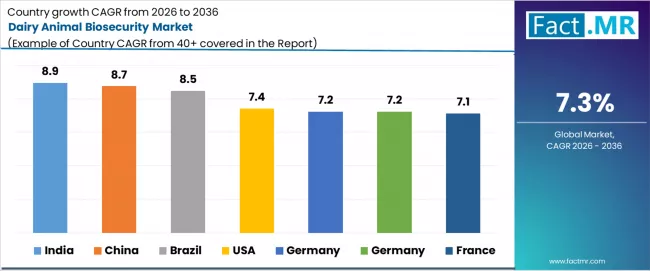
Growth prospects vary significantly by region. India is expected to lead global expansion with a projected CAGR of 8.9%, driven by efforts to boost milk productivity while controlling endemic diseases such as foot-and-mouth disease through scalable, cooperative-based biosecurity programs.
China follows closely with an estimated 8.7% CAGR, supported by state-backed consolidation into mega-farms capable of implementing closed-loop biosecurity systems with strict control over animal movement and inputs.
Brazil’s market is projected to grow at 8.5%, reflecting its ambition to expand dairy exports and meet international animal health standards. This growth is encouraging investments in perimeter control and transport hygiene solutions adapted to extensive production systems.
In the United States, a projected 7.4% CAGR is closely linked to consumer-driven pressure to reduce antibiotic use. This has shifted the focus toward preventative vaccination programs and advanced environmental management to maintain herd health without reliance on therapeutics.
European markets such as Germany, the United Kingdom and France are showing steady growth around 7%, with emphasis on data-driven risk analytics, pasture-adapted protocols and post-Brexit regulatory adjustments.
Competitive landscape
The competitive environment includes global animal health leaders such as Zoetis, Boehringer Ingelheim Animal Health, Elanco Animal Health, Neogen Corporation and Ceva Santé Animale, alongside specialized hygiene and diagnostics providers.
Success in the dairy animal biosecurity market is increasingly tied to offering integrated system solutions rather than individual products. Companies are forming partnerships to deliver combined packages of vaccines, diagnostics, disinfectants and data management tools, positioning biosecurity as a strategic platform for long-term herd health and farm profitability.
Written for eDairyNews, with information from Fact.MR.